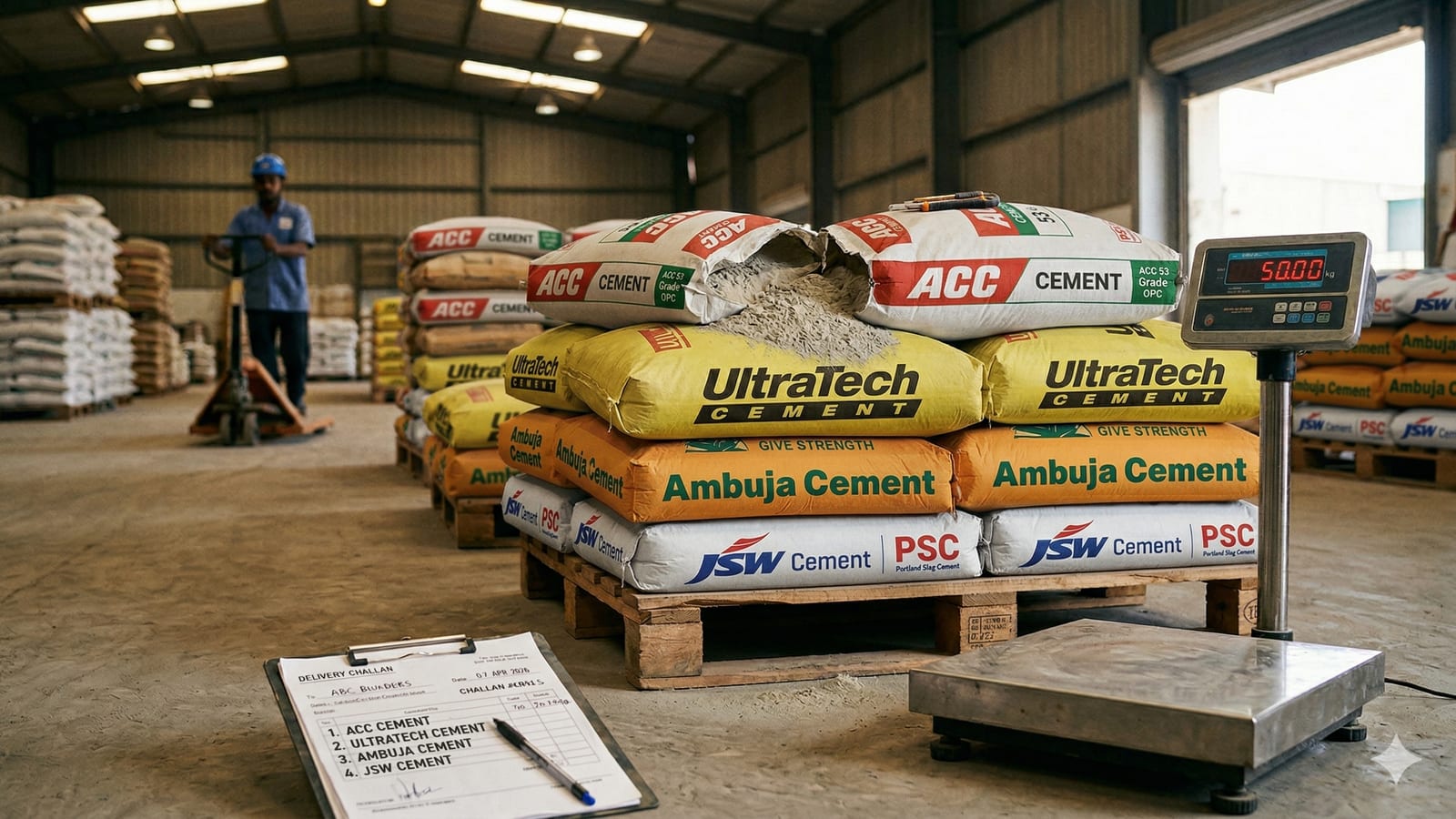
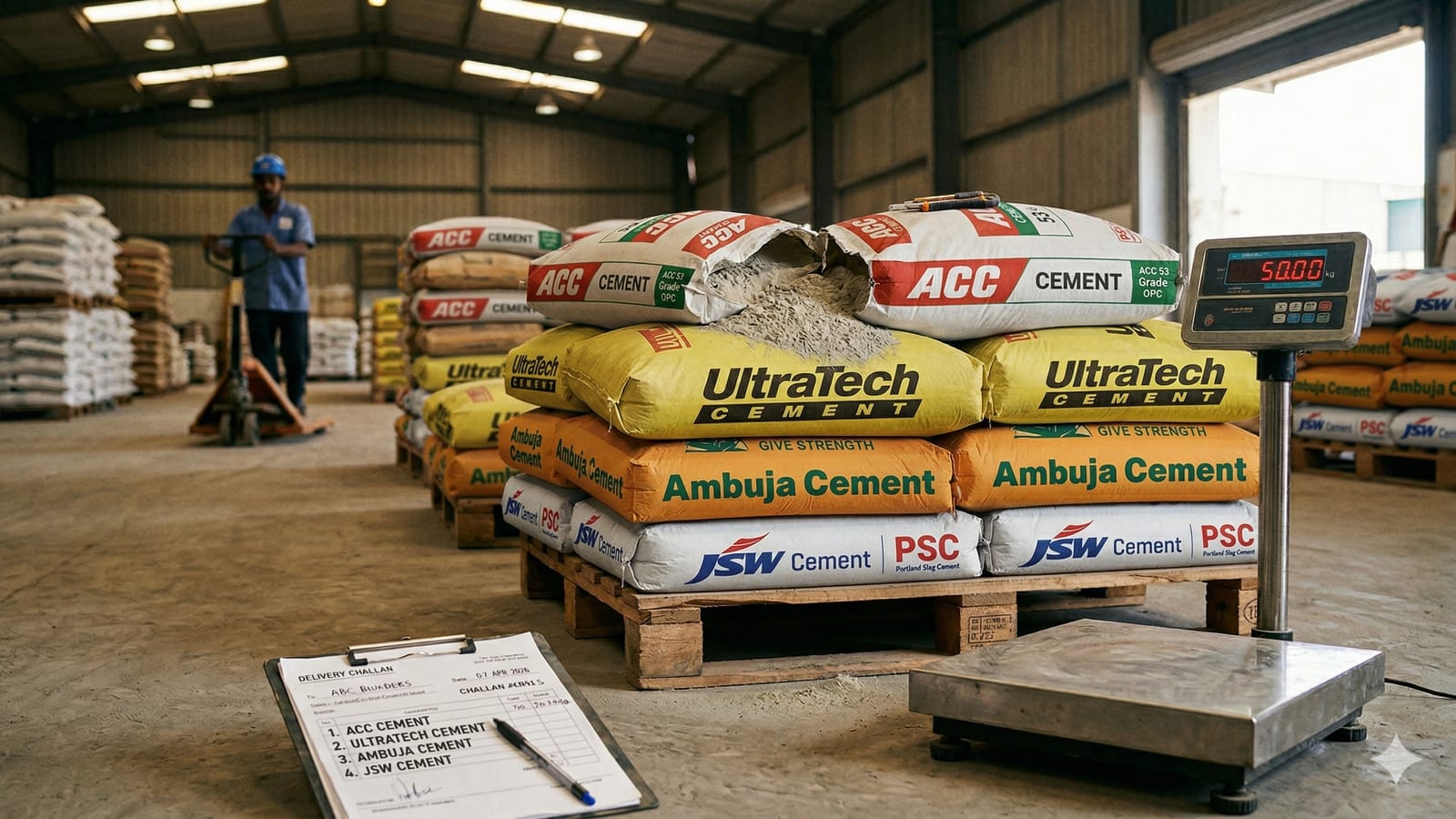
If you are building a house in 2026, the short answer is this: use PPC for most general construction such as foundations, plastering and brickwork, use OPC 53 grade for RCC structural work like columns, beams and slabs, and reserve PSC for mass concreting or sites with high sulphate or coastal exposure. The rest of this guide walks through the strength numbers, setting times, IS codes and real trade-offs so you can buy with confidence.
OPC vs PPC vs PSC: The Quick Comparison
Here is how the three cement families stack up on the factors that actually matter on site.
| Cement Type | Compressive Strength (28 days) | Setting Time | Best Use | Cost |
|---|---|---|---|---|
| OPC 43 Grade | 43 MPa minimum | Initial set from 30 minutes, final set within 600 minutes | General RCC, plastering, low to mid-rise homes | Check live prices on Clyft |
| OPC 53 Grade | 53 MPa minimum | Similar limits to OPC 43, faster early strength gain | High-strength RCC: columns, beams, slabs, precast | Check live prices on Clyft |
| PPC | Comparable to OPC 43 by 28 days, higher long-term gain | Slower early strength gain, same regulatory setting-time limits | General construction, plastering, humid or coastal areas | Check live prices on Clyft |
| PSC | Comparable to OPC by 90 days as slag cures | Slow initial set, strength develops over months | Mass concrete, marine and water-retaining structures | Check live prices on Clyft |
What Is OPC (Ordinary Portland Cement)?
OPC is the original, no-additive cement: clinker ground together with a small amount of gypsum to control setting time. It is manufactured under the IS 269 specification, the foundational OPC standard, with the higher grades governed by their own dedicated codes, IS 8112 for 43 grade and IS 12269 for 53 grade. The grade number tells you the minimum compressive strength, in MPa, the cement must reach after 28 days of standard curing.
OPC 43 Grade
OPC 43 grade must achieve a minimum compressive strength of 43 MPa after 28 days under standard test conditions. It is the most common grade for general residential work such as plastering, flooring, brickwork and RCC in low to mid-rise homes, where very high early strength is not critical.
OPC 53 Grade
OPC 53 grade is rated for a minimum of 53 MPa at 28 days and also gains strength faster in the first week than 43 grade. It costs a little more per bag, but some mix designs need less cement for the same target strength. It is generally preferred for RCC columns, beams, slabs and precast elements in multi-storey buildings, and for concrete roads.
What Is PPC (Portland Pozzolana Cement)?
PPC is made by blending OPC clinker with 15 to 35 percent fly ash, a by-product of coal-based power plants, under IS 1489 (Part 1). The fly ash reacts with the calcium hydroxide released during hydration, a pozzolanic reaction that lowers the heat of hydration, reduces the risk of shrinkage cracks, and improves long-term resistance to sulphates and chlorides. Early strength, at 3 to 7 days, is slightly lower than OPC, but by 28 to 90 days PPC concrete typically matches or exceeds OPC 43 while staying more durable in humid or coastal conditions. PPC is the most widely used cement for general house construction in India today, and is usually the most budget-friendly option per bag.
What Is PSC (Portland Slag Cement)?
PSC replaces 25 to 70 percent of the clinker with ground granulated blast furnace slag, a by-product of steel manufacturing, under IS 455. Like PPC, it has a slower initial strength gain and a lower heat of hydration, which makes it well suited to mass concreting: large, thick pours like foundations, retaining walls and dams, where heat build-up can otherwise cause cracking. It also resists sulphate and chloride attack strongly, making it a common choice for marine structures, sewage treatment plants and foundations in soil with high sulphate content. PSC is stocked less widely than PPC in most retail markets, but it is a strong pick for the right site conditions.
Which Cement Should You Choose for Your House?
As a practical starting point:
- Foundation and footing: PPC or PSC, for lower heat of hydration and good long-term durability.
- Columns, beams and slabs (RCC): OPC 53 grade for higher early strength, or PPC where speed of construction is not critical.
- Plastering and brickwork: PPC, for cost-effective, workable mortar.
- Water tanks, basements and coastal homes: PPC or PSC, for chloride and sulphate resistance.
- General, budget-conscious homes: PPC is the safe default most contractors already use.
Whichever grade you choose, buy from a fresh batch. Check the manufacturing date printed on the bag, since cement can lose roughly a fifth of its strength after about three months of storage, and always store bags off the ground and away from moisture.
Frequently Asked Questions
Which is better, OPC or PPC, for house construction?
Neither is strictly better for every job. OPC 53 grade gains strength faster and suits load-bearing RCC members, while PPC is more durable in humid or coastal conditions and is usually cheaper, which is why most Indian homes now use PPC for the bulk of construction and OPC 53 only where the structural design calls for it.
Can I mix OPC and PPC cement in the same house?
Yes. It is common and acceptable to use OPC 53 for RCC structural members like columns, beams and slabs, and PPC for plastering, brickwork and flooring in the same build, as long as each is used according to the structural engineer's mix design.
What does the grade number in OPC 43 or OPC 53 mean?
The number is the minimum compressive strength, in MPa (megapascals), that the cement must reach after 28 days of standard curing, as tested under Indian Standard methods. A higher grade generally means higher early and 28-day strength, not a different chemical composition.
Is PSC cement suitable for a residential building?
PSC is used less often in typical residential construction because its strength develops slowly, which does not suit fast-track construction. It is a good choice for the foundation or basement of a home in coastal areas or on soil with high sulphate content, where resistance to chemical attack matters more than early strength.
Ready to buy cement?
Best prices, direct from manufacturers, delivered to your doorstep.