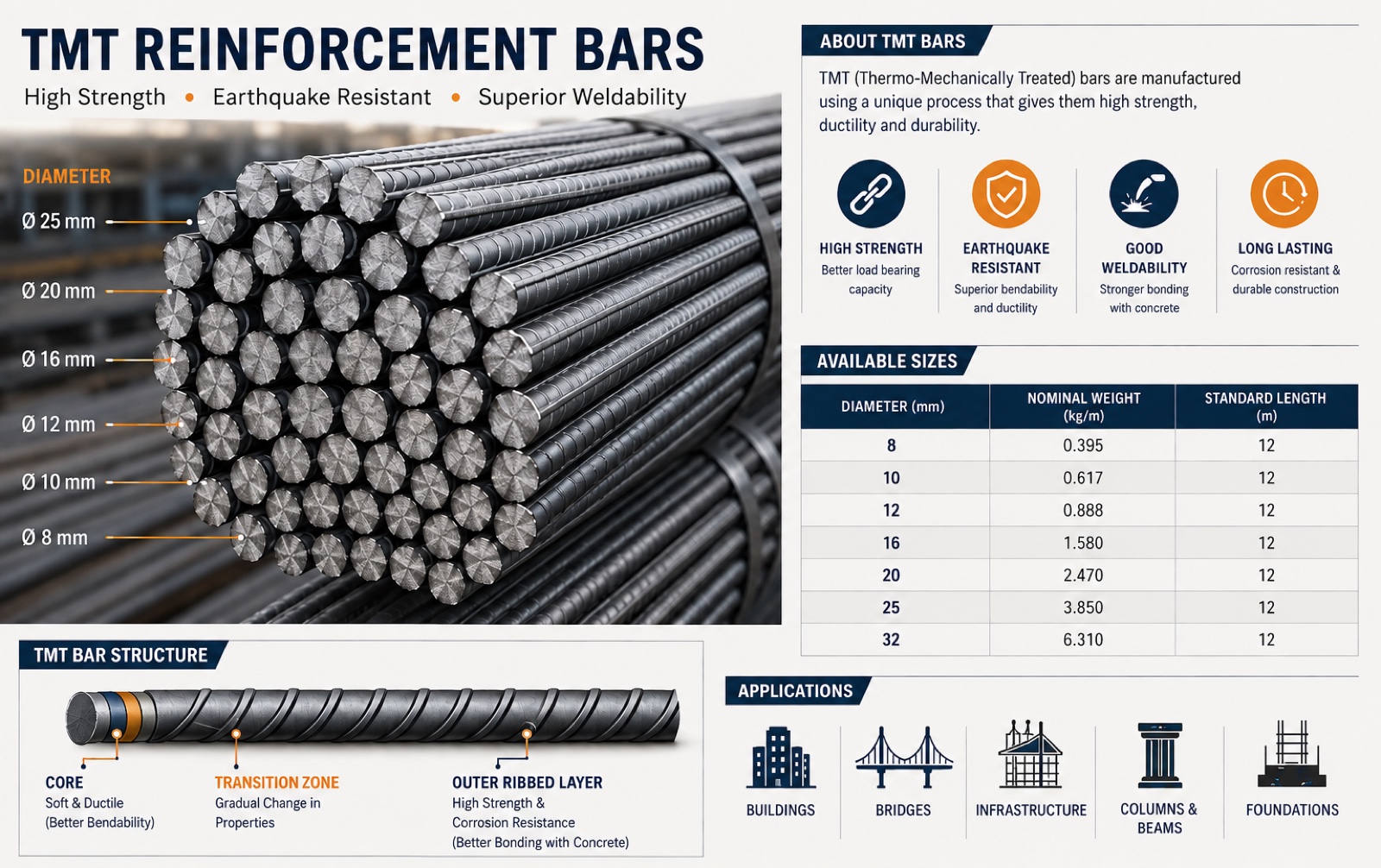
TMT (Thermo-Mechanically Treated) steel bars are the skeleton of your building, so grade, size and genuine quality matter more here than almost anywhere else. This guide covers the grades sold in India, the standard bar sizes and their weights, the IS code to check, how to spot real quality, and how to estimate how much steel your build needs.
Quick answer: which grade and where
| Grade | Key property | Typical use |
|---|---|---|
| Fe500 | Strength and workability | General residential and commercial RCC |
| Fe500D | Higher ductility, lower carbon | Homes in seismic zones, most house construction |
| Fe550 / Fe550D | Higher tensile strength | Heavier structural loads, larger buildings |
For most homes, Fe500D is the sensible default. Step up to Fe550 only when the structural design calls for it.
Understanding grades
The number (500, 550) is the minimum yield strength in MPa. The letter D signals higher ductility and lower carbon and sulphur, which lets the frame deform without sudden brittle failure, valuable in earthquake-prone regions. Higher strength alone is not the goal; ductility is what keeps a home standing under an unexpected load. Our Fe500 vs Fe500D deep dive explains the trade-offs in detail.
Bar sizes and weight
TMT bars are sold by diameter, and weight follows the standard formula d squared divided by 162 kilograms per metre, where d is the diameter in millimetres:
| Diameter | Approx. weight (kg per metre) | Common use |
|---|---|---|
| 8 mm | 0.395 | Slabs, stirrups |
| 10 mm | 0.617 | Slabs, distribution steel |
| 12 mm | 0.888 | Beams, columns |
| 16 mm | 1.580 | Beams, columns |
| 20 mm | 2.470 | Columns, foundations |
| 25 mm | 3.858 | Heavily loaded members |
Because steel is bought by weight but placed by length, this chart is what turns your bar bending schedule into a purchase order.
Which standard to check
All TMT reinforcement bars in India are made to IS 1786, the Bureau of Indian Standards code for high-strength deformed steel bars. The grade and standard are rolled directly onto the bar. If you cannot find the IS 1786 mark and a recognised manufacturer name on the steel, do not buy it.
How much steel you need
For a quick budget, a residential build uses roughly 3 to 5 kg of steel per square foot of built-up area, rising with the number of floors. This is only for early estimation. The accurate quantity comes from the structural bar bending schedule, which lists every bar by size and length. Our steel quantity per square foot guide walks through both the thumb rule and the proper calculation.
What affects the price
TMT steel is priced per kilogram and tracks iron ore and scrap prices, coal and power costs, freight, and regional demand, so rates move week to week. Branded bars carry a small premium for consistent quality control. Our guide on TMT steel prices in India explains how to read a fair per-kg rate.
Buying checklist
- Confirm the grade (usually Fe500D) matches the structural drawing.
- Check for the IS 1786 mark and manufacturer name on the bar.
- Inspect for a uniform rib pattern and no loose rust or black patches.
- Order by the bar bending schedule, converting length to weight with the chart above.
- Prefer branded steel from a trusted supplier for guaranteed quality.
Buy TMT steel on Clyft
Clyft delivers branded TMT bars direct from manufacturers across Hyderabad and up to 50 km around the city, usually within 24 hours, with transparent per-kg pricing. Browse live options in the TMT steel collection or order on the Clyft app.