For most residential work in India, M20 concrete with a nominal mix of 1 part cement to 1.5 parts sand to 3 parts aggregate is the standard for slabs, beams and columns, while M15 (1:2:4) suits flooring and plain concrete work, and M25 and above should ideally be a design mix rather than a nominal one. For 1 cubic metre of M20 concrete you need roughly 8 bags of cement, 0.42 cubic metres of sand and 0.84 cubic metres of coarse aggregate. The tables below break down every common grade and show you how to size material quantities for your own slab.
What Is a Concrete Mix Ratio?
A concrete mix ratio states the proportion, by volume, of cement to sand (fine aggregate) to coarse aggregate that goes into a batch of concrete. It is written as three numbers, cement to sand to aggregate, for example 1:1.5:3 for M20. The nominal mix method fixes these ratios for lower grades based on decades of standard practice, while a design mix calculates exact proportions in a lab for a target strength and the specific materials at hand, as required for higher grades under IS 456.
Concrete Grade to Mix Ratio Table
The table below lists the standard nominal mix ratios recognised for common concrete grades, along with where each is typically used in a residential build.
| Grade | Nominal ratio (cement:sand:aggregate) | Typical use |
|---|---|---|
| M5 | 1:5:10 | Sub-base and blinding layers |
| M7.5 | 1:4:8 | Base for flooring, non-structural fill |
| M10 | 1:3:6 | PCC (plain cement concrete), levelling course |
| M15 | 1:2:4 | Flooring, PCC below footings |
| M20 | 1:1.5:3 | Slabs, beams and columns in residential RCC |
| M25 | 1:1:2 | Columns and heavier RCC members, ideally as a design mix |
Grades above M25, M30 and higher, should always be a design mix rather than a nominal mix. A design mix is calculated in a lab for the actual cement, sand and aggregate you are using and the exact target strength, rather than relying on the fixed ratios above, and IS 456 requires this for higher grades because the margin for error at higher strength targets is too small for a one-size-fits-all ratio.
What Is M20 Concrete, and Why Is It So Common?
The "M" stands for mix and the number that follows is the target compressive strength in MPa (N/mm2) after 28 days of curing, tested on standard cubes. M20 concrete is designed to reach a minimum of 20 MPa, and it is the default grade for slabs, beams and columns in most low and mid-rise residential buildings in India, since it offers a comfortable strength margin for typical structural loads without the tighter quality control that higher grades demand. Where a structural engineer's design calls for something stronger, higher floors, heavier spans or additional loads, M25 or above is specified instead, usually as a design mix.
How Much Cement, Sand and Aggregate Do You Need for 1 m3 of M20 Concrete?
Concrete is batched dry, as loose cement, sand and aggregate, but measured wet, as the finished concrete volume you actually pour, and dry materials take up more space than they do once compacted and bound together with water. To get 1 cubic metre of finished, wet M20 concrete, you need roughly 1.54 cubic metres of dry material, a factor engineers apply as standard.
Working through the 1:1.5:3 ratio with this dry volume factor gives the following approximate quantities for 1 m3 of M20 concrete:
| Material | Quantity for 1 m3 of M20 |
|---|---|
| Cement | About 403 kg, roughly 8 bags of 50 kg |
| Sand (fine aggregate) | About 0.42 m3 |
| Coarse aggregate | About 0.84 m3 |
| Water | About 180 to 200 litres |
The water quantity follows from the water-cement ratio, typically kept between 0.45 and 0.5 for M20 concrete. Too much water weakens the finished concrete even if the mix ratio is otherwise correct, so this figure is a maximum guide, not a target to always use in full, especially in hot weather where you may need to compensate for evaporation rather than adding more mixing water.
How to Calculate Materials for Your Own Slab
Here is a worked example for a small residential roof slab measuring 10 feet by 10 feet at a thickness of 5 inches, a fairly typical size for a single room.
- Convert to metres. 10 ft is about 3.05 m, so the slab is 3.05 m by 3.05 m. A thickness of 5 inches is about 0.127 m.
- Find the wet volume. 3.05 x 3.05 x 0.127 works out to about 1.18 cubic metres of concrete.
- Apply the M20 quantities per cubic metre. Multiply the 1 m3 figures above by 1.18: roughly 9.5 bags of cement, about 0.5 m3 of sand, and about 0.99 m3 of coarse aggregate.
- Round up and add a margin. Always round up to the next full bag of cement, and add a small buffer, typically 5 to 10 percent, for wastage, spillage and an uneven sub-surface, rather than ordering the bare calculated minimum.
The same four steps work for any slab, beam or column: convert your dimensions to metres, multiply to get the wet volume in cubic metres, multiply by the per-m3 quantities for your chosen grade, then round up with a margin.
M20 vs M25: Which Should You Use?
M20 and M25 both fall in the range commonly used for residential RCC, but they are not interchangeable by default. M25 uses proportionally more cement per cubic metre than M20, a richer mix, closer to 1:1:2 versus 1:1.5:3, which raises both its target strength and its material cost. M20 is the standard choice for slabs, beams and columns in typical low-rise homes, while M25 is generally reserved for columns and members carrying higher loads, taller buildings, or wherever a structural engineer's calculations specifically call for the extra strength margin. Since M25 sits at the point where IS 456 recommends a design mix rather than a nominal one, get your exact proportions confirmed against your actual site materials rather than relying on the nominal ratio alone if you are building anything beyond a simple, low-rise structure.
Buying Cement for Your Slab
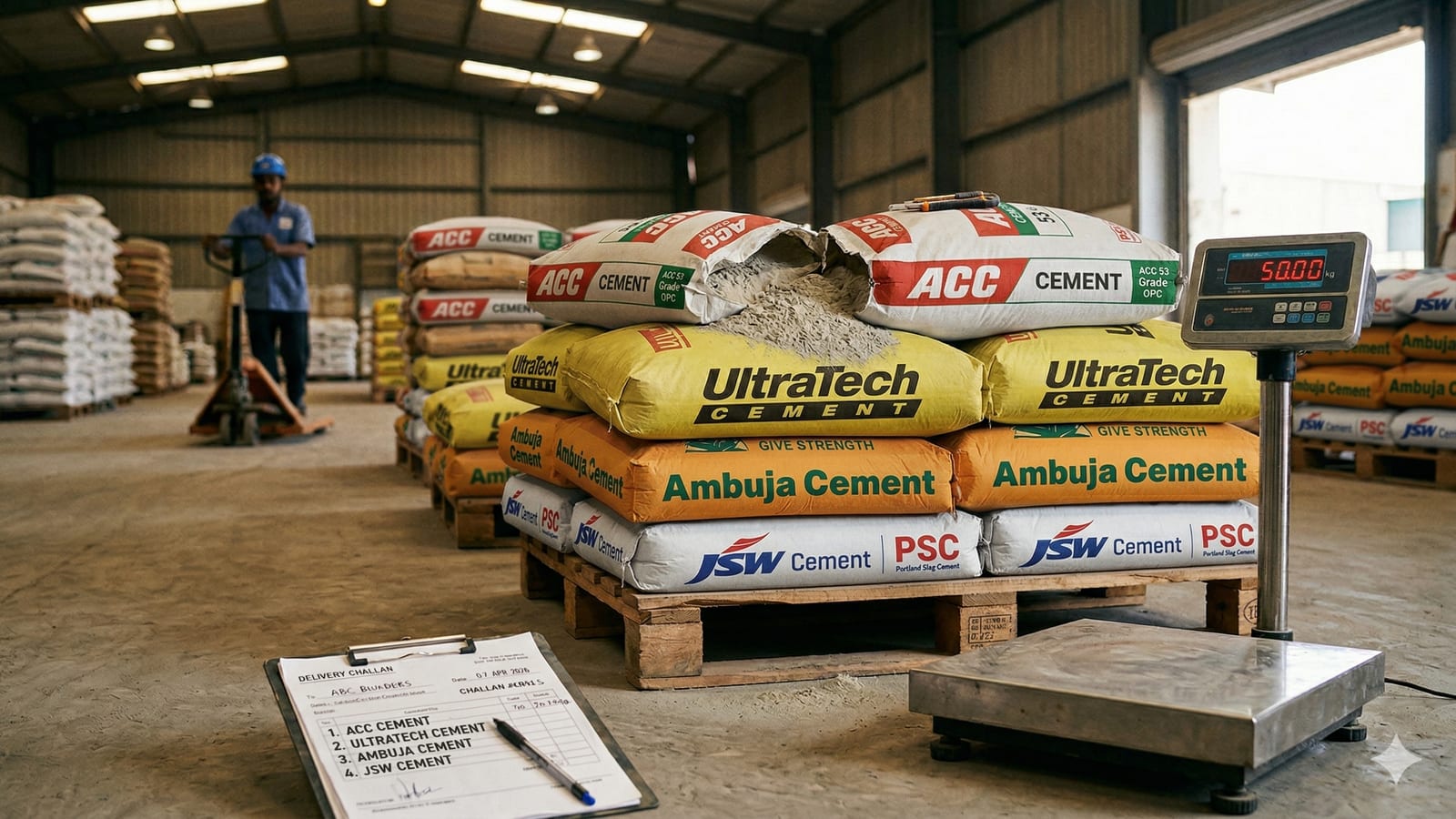
Once you know how many bags your slab or pour needs, buy with a small margin built in rather than the bare calculated number, since spillage, minor thickness variation and an uneven base all eat into the exact figure. Compare OPC and PPC pricing for the grade your engineer has specified, and check today's live prices on Clyft before placing a bulk order, so you are working from current rates rather than an old quote.