For structural concrete in most of India today, M sand is the sensible default, and Robo sand is simply M sand from a particular brand rather than a different material. River sand remains slightly better for the final coats of plaster where surface finish matters most. Crusher dust, despite looking similar and costing less, is not a substitute for either and does not belong in structural concrete. This guide explains what separates them and where each one actually belongs in a build.
What Are These Four Materials?
Half the confusion in this comparison comes from names rather than materials, so it is worth setting out plainly what each term refers to.
| Name | What it actually is | Origin |
|---|---|---|
| River sand | Natural sand, rounded by water over time | Dredged from riverbeds |
| M sand | Manufactured sand, crushed and graded to IS 383 | Crushed hard rock, usually granite |
| Robo sand | M sand sold under the Robo Silicon brand | Crushed hard rock, one manufacturer |
| Crusher dust | Ungraded fine by-product of aggregate crushing | Left over at the crusher |
River Sand
River sand is the traditional material, and its particles are rounded and smooth because they have been tumbled by flowing water for a very long time. That shape is what gives river sand its famous workability: rounded grains roll past each other easily, so mortar and concrete made with it feel plastic and spread smoothly under a trowel.
Its weaknesses are supply and consistency. River sand carries silt and clay in variable amounts depending on where it was dredged, and silt coats the grains and weakens the bond between cement paste and sand. It also arrives with no guaranteed grading, so two loads from different sources can behave differently in the same mix design. On top of that, dredging is now restricted or banned across large parts of India, which has made legal river sand expensive, seasonal and in some districts effectively unavailable.
M Sand
Manufactured sand is made deliberately rather than collected. Hard rock, usually granite, is crushed in a vertical shaft impactor that shapes the particles, then the output is washed to remove fines and screened to a controlled particle size distribution meeting IS 383.
The result is consistent from load to load, essentially silt free, and available year round independent of river dredging rules. Its particles are angular rather than rounded, and that single physical difference explains almost everything else about how M sand behaves: better mechanical interlock and therefore good strength, but lower workability at the same water content than river sand.
Robo Sand
Robo sand is not a third material. Robo Silicon was an early and large manufactured sand producer in South India, and across Telangana, Andhra Pradesh and Karnataka the brand name became the generic term, in the way people say Xerox for photocopy. When a supplier in Hyderabad quotes Robo sand, they mean manufactured sand.
The brand does distinguish its own product lines, most usefully between a concrete grade and a finer plastering grade, and that grade distinction is the one genuinely worth asking about. Whether you buy Robo Silicon or another producer's M sand, what matters is the same in both cases: that it is washed, graded and comes with a test report.
Crusher Dust
Crusher dust, also sold as quarry dust, is what is left at the bottom of the crusher after aggregate is screened out. It looks superficially like M sand and costs noticeably less, which is exactly why it gets substituted.
It should not be. Crusher dust is neither washed nor graded, so it carries a much higher proportion of very fine particles than a specification allows. Those fines raise the water demand of the mix sharply, and more water at the same cement content means lower strength and more shrinkage cracking. Crusher dust has legitimate uses in non-structural fill, paver bedding and sub-base work. Structural concrete is not one of them.
Head to Head Comparison
| Property | River sand | M sand / Robo sand | Crusher dust |
|---|---|---|---|
| Particle shape | Rounded | Angular, shaped | Angular, irregular |
| Silt content | Variable, often 3 to 20% | Under 1%, washed | High fines |
| Grading consistency | Varies by source | Controlled to IS 383 | Ungraded |
| Concrete strength | Good | Equal or slightly higher | Lower |
| Workability | Best | Slightly lower, adjustable | Poor, high water demand |
| Availability | Restricted, seasonal | Year round | Widely available |
| Price stability | Volatile | Stable | Cheapest |
| Best use | Final plaster coats | Structural concrete, blockwork | Fill and sub-base only |
Which Sand Is Best for Concrete?
M sand, in almost every practical case. Three reasons carry the decision.
Grading consistency is the first and most underrated. Concrete mix design assumes a particular particle size distribution, and M sand is manufactured to hit that distribution every load. River sand varies by source and by season, so a mix that worked last month can behave differently this month with no change to the cement or aggregate.
Silt is the second. Silt and clay coat sand grains and physically interfere with the bond between cement paste and aggregate, and river sand routinely arrives well above the roughly 3 percent silt limit that concrete sand should meet. Washed M sand is effectively silt free.
Particle interlock is the third. Angular particles key into each other under load in a way rounded particles do not, which is why well graded M sand typically matches or slightly beats river sand on compressive strength for the same mix design.
The one real adjustment M sand needs is water. Angular particles resist flowing past each other, so a mix made with M sand is stiffer than the same mix with river sand. The correct response is a small increase in water with a plasticiser to hold the water to cement ratio, or simply a plasticiser on its own. The incorrect response, and a common one on site, is to add water freely until the mix looks familiar, which raises the water to cement ratio and gives away the strength advantage you were buying. If you are setting proportions, the concrete mix ratio guide covers how cement, sand and aggregate should be balanced by grade.
Which Sand Is Best for Plastering?
This is where river sand keeps a genuine edge, and where most complaints about M sand come from.
Plaster is judged on surface finish, and finish depends on fine, rounded particles that let a trowel glide and close the surface. Coarse concrete grade M sand does the opposite: it is angular and too coarse for a finish coat, so the plaster feels harsh, drags under the trowel and can show a rough texture.
The fix is grade, not material. P sand, manufactured sand screened to a finer plastering grading, is made for exactly this and performs well for both internal and external plaster. When ordering, be explicit about plastering grade rather than assuming a supplier will send it, because concrete grade is the default in most yards.
A reasonable approach on a full build is M sand or Robo sand for all concrete and blockwork, P sand for plaster coats, and river sand only if it is legally available at sensible cost and you specifically want it for a finish coat.
How to Check Sand Quality on Site
Two quick checks catch most bad material before it goes into a mix.
The silt test. Fill a transparent bottle about halfway with sand, top up with water, shake it hard and leave it to stand for a few hours. Silt settles as a distinct layer on top of the sand. If that layer is more than roughly 3 percent of the sand depth, the material needs washing before it goes into structural concrete.
The hand test. Squeeze a handful of damp sand and open your palm. Clean sand falls apart and leaves your hand largely clean. Sand that holds its shape in a firm ball and leaves a fine film on your skin is carrying clay, which is the same bond problem as silt.
For any significant quantity, ask the supplier for a test report covering grading zone under IS 383, silt content and fineness modulus. A producer of washed and graded M sand will have one. A yard selling crusher dust as M sand generally will not, which is the simplest way to tell the two apart before delivery.
A Note on What Clyft Supplies
Clyft does not currently stock sand. This guide exists because it is one of the questions buyers ask most often while planning a build, and getting it wrong is expensive in a way that is hard to reverse once concrete has set.
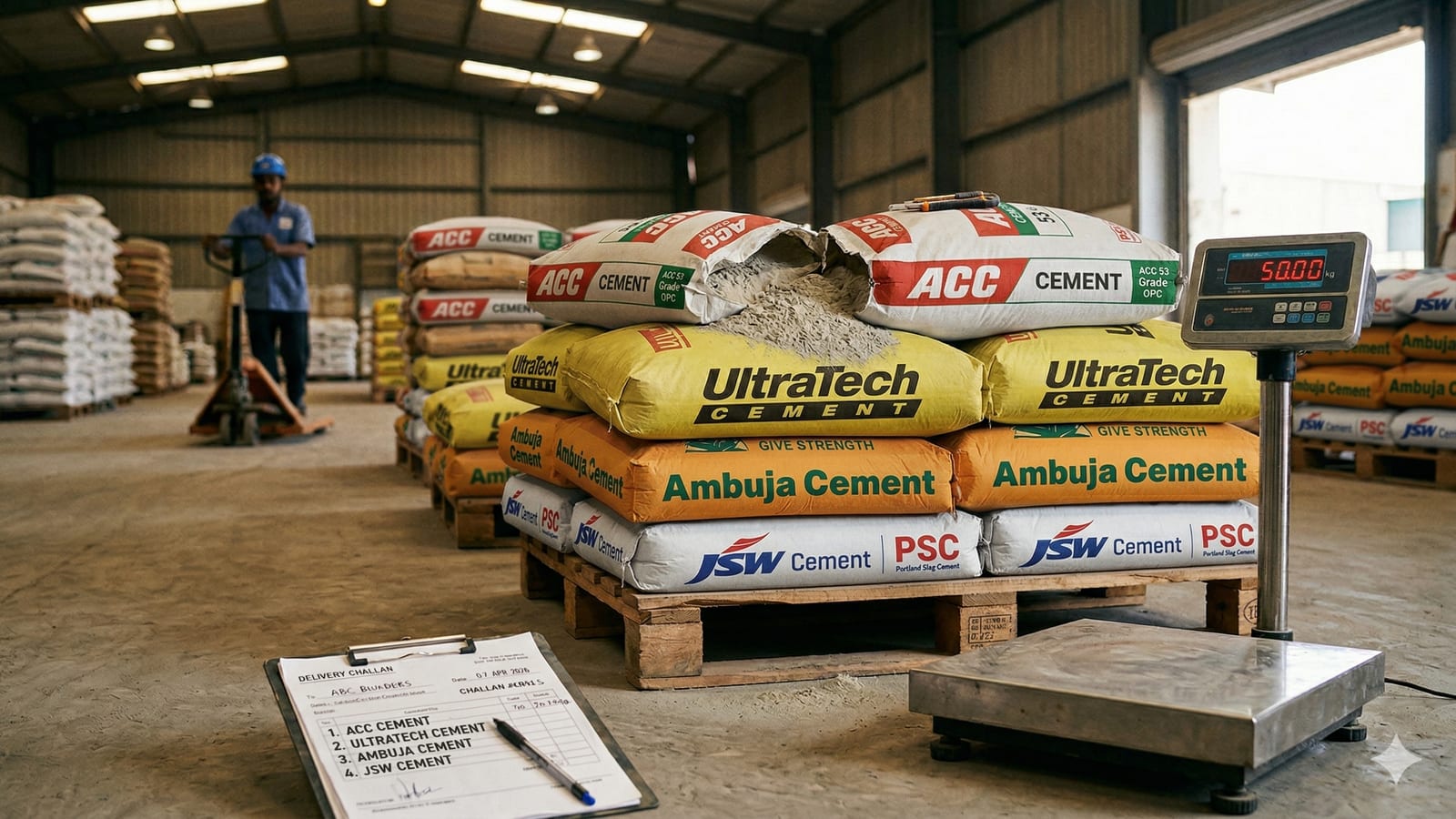
What we do supply is the rest of the structural material list, including cement across OPC, PPC and PSC grades, TMT steel, red bricks and AAC blocks. If you are working out quantities for a slab or a full build, the construction calculator will size the material list, and the cement grade guide covers which cement belongs in which part of the structure.
Get the lowest prices in Hyderabad in just 10 minutes!
Tell us the brand and quantity. Verified suppliers quote, you see the lowest, and most orders arrive within 24 hours.