Plywood grades are really about the glue, not the thickness. MR ply resists humidity for dry interiors, BWR ply handles the occasional splash in kitchens and bathrooms, and BWP or marine ply (IS 710) uses fully waterproof glue for wet and outdoor use. Here is what each grade means and how to choose.
MR vs BWR vs BWP: grades at a glance
| Grade | Full name | IS code | Water resistance | Best use |
|---|---|---|---|---|
| MR | Moisture Resistant (commercial ply) | IS 303 | Resists humidity, not soaking | Wardrobes, bedroom furniture, dry interiors |
| BWR | Boiling Water Resistant | IS 303 | Handles occasional water and humidity | Kitchens, bathroom vanities |
| BWP | Boiling Water Proof (marine) | IS 710 | Fully waterproof glue | Wet and outdoor areas, exteriors, long life |
MR plywood (moisture resistant)
MR ply, often sold as commercial plywood, is made to IS 303. The name is honest about its limits: it resists moisture and humidity in the air, but it is not built to survive water soaking or standing water. Bonded with a urea-formaldehyde based adhesive, it is the economical choice for dry, indoor furniture that never meets water, such as wardrobes, bedroom units, cupboards and study tables. Use it where the ply stays dry and you want to keep cost down.
BWR plywood (boiling water resistant)
BWR ply is also made under IS 303, but uses an improved, more water-resistant bond, so it copes with occasional water contact and higher humidity. That makes it the practical middle grade for kitchens, bathroom vanities and any indoor spot that sees the odd splash or steam without being permanently wet. If your furniture lives in a damp room but is not standing in water, BWR is usually the sensible balance of cost and durability.
BWP and marine plywood (IS 710)
BWP stands for Boiling Water Proof, and it is the same product sold as marine plywood. It is manufactured to a stricter standard, IS 710, and bonded with a phenol-formaldehyde glue that is genuinely waterproof, so the plies do not separate even with prolonged water exposure. This is the grade for the wettest and most demanding jobs: kitchen cabinets around the sink, bathroom units, outdoor and semi-outdoor work, and anything that needs to last for years in humid conditions. Marine-grade ply is also what you are getting when the number 710 appears on the sheet, since that number is simply the IS code for this boiling-water-proof grade.
It is the glue and the core, not just the thickness
The single biggest difference between grades is the adhesive. MR ply uses a urea-based glue that softens with water, while BWP ply uses a phenolic glue that does not, which is why marine ply survives soaking that would delaminate a commercial sheet.
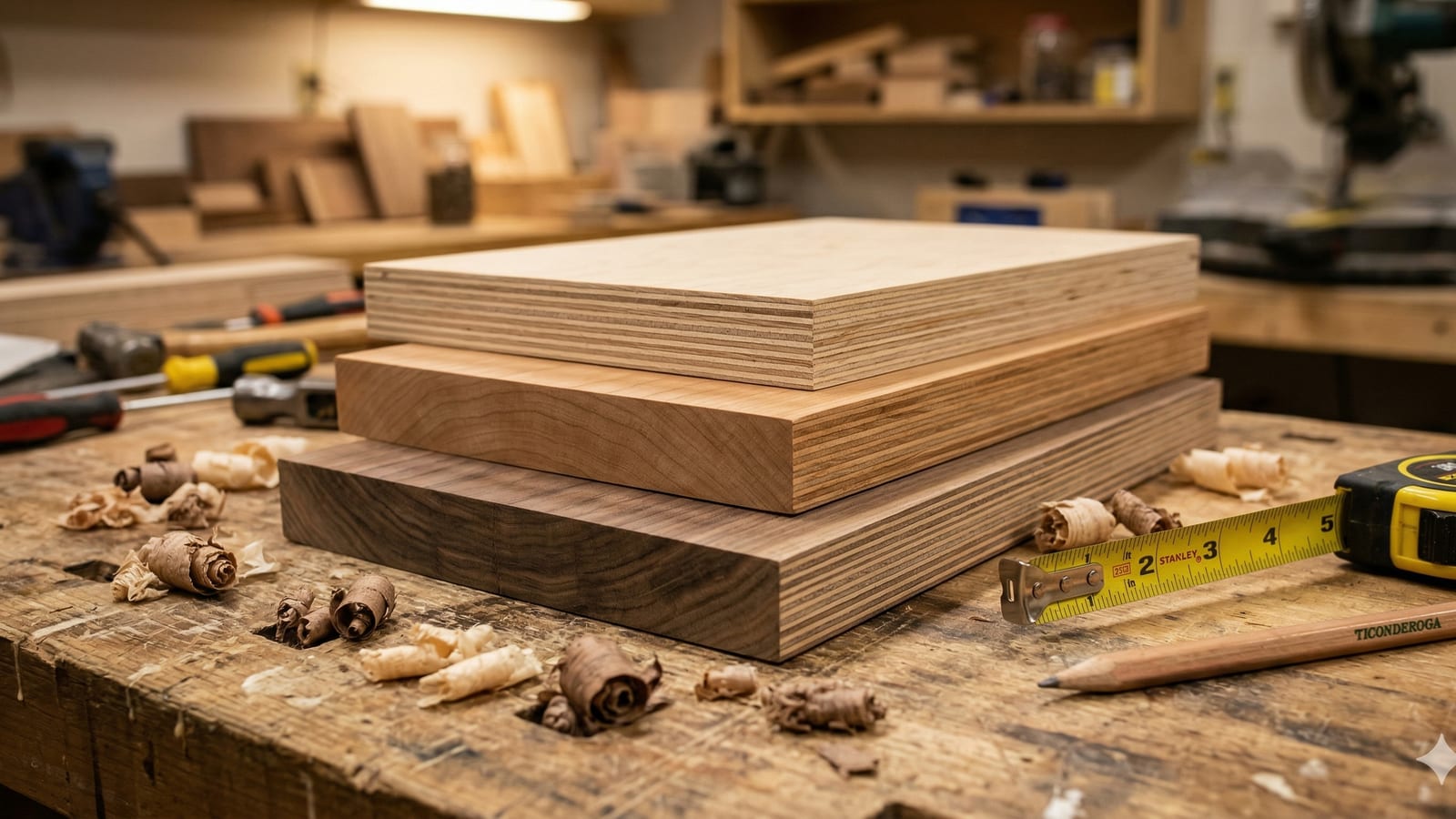
Core quality matters too. Better ply uses a dense hardwood core, often gurjan, with full, gap-free veneers and no internal hollows, and calibrated ply is sanded to a precise, uniform thickness so panels sit flush. Two sheets of the same thickness can behave very differently depending on the glue and core inside them, so grade and core quality matter more than the millimetre count alone.
Plywood thickness guide
Grade tells you where the ply can live; thickness tells you what it can carry. Common options and typical uses:
| Thickness | Typical use |
|---|---|
| 4 to 6 mm | Cabinet backs, drawer bottoms, panelling, flush surfaces |
| 9 mm | Light partitions, small shelves, drawer sides |
| 12 mm | General furniture, shelves, table tops with support |
| 16 to 19 mm | Shutters, doors, wardrobe carcasses, load-bearing shelves |
As a rule, use thinner sheets (4 to 6 mm) for backing and panels, and thicker sheets (12 to 19 mm) for shelves, shutters and doors that must hold weight without sagging.
Which grade for which room?
Matching grade to location is the whole game:
- Bedrooms and living rooms (dry): MR ply is enough for wardrobes, beds, cupboards and study units.
- Kitchens and bathrooms (damp): use BWR at a minimum, and BWP (marine) for cabinets around the sink, tap and cooking zone.
- Balconies, exteriors and anything semi-outdoor: BWP marine ply, every time.
Spending up from MR to BWR or BWP costs more per sheet, but in a room that sees water it is cheaper than replacing swollen, delaminated furniture a few years later. When in doubt in a wet zone, go one grade higher.
How to check plywood quality before buying
A few quick checks separate good ply from poor:
- Look for the ISI mark and IS code: IS 303 for MR and BWR, IS 710 for BWP or marine.
- Inspect the edge: the core veneers should be even and gap-free, with no hollows or overlaps.
- Check the glue line: it should be continuous and uniform along the edge.
- Lift the sheet: a heavier board usually means a denser core and better quality.
- Ask about the core: a hardwood or gurjan core and a calibrated, uniformly sanded finish are signs of a better sheet.
- Check the emission class: better ply is certified to a low formaldehyde emission grade such as E1 or E0, which is healthier for indoor air.
Match the grade to the room and the thickness to the load, buy an ISI-marked sheet, and your plywood will outlast the furniture it goes into.