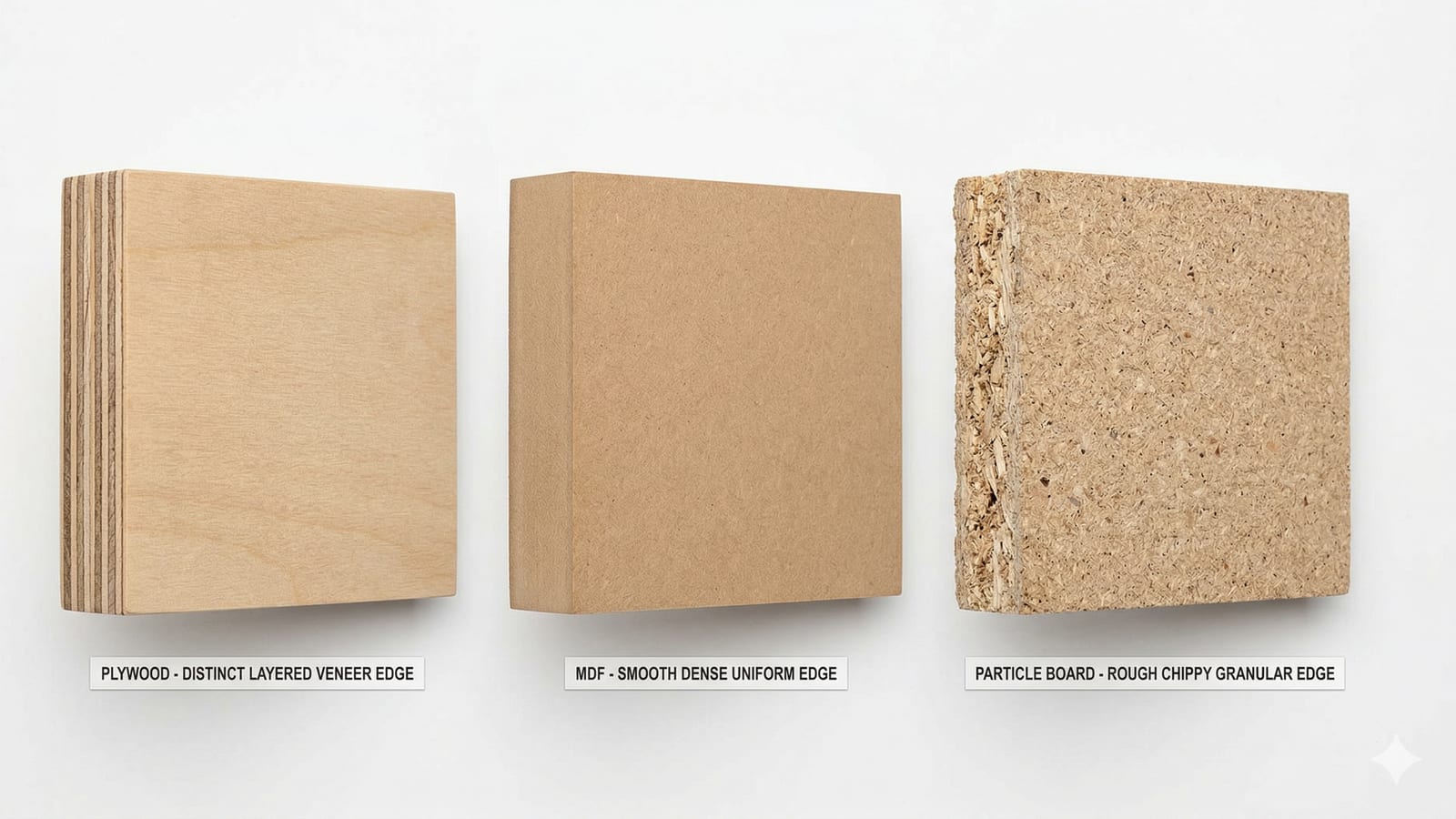
The short answer: plywood is the strongest and most water-tolerant, so use it for kitchens, wardrobes, doors and anything structural or damp; MDF gives the smoothest surface for paint and carving; and particle board is the cheapest option for dry, ready-made furniture. Here is how the three engineered boards compare in detail.
Plywood vs MDF vs particle board: comparison table
| Property | Plywood | MDF | Particle Board |
|---|---|---|---|
| Made of | Thin wood veneers glued in cross-laid layers (odd number) | Fine wood fibres compressed with resin | Wood chips and sawdust bonded with resin |
| Strength | Highest | Medium | Lowest |
| Screw holding | Strong, holds well even on edges | Weak on edges | Weak |
| Moisture resistance | Best, especially BWR and BWP grades | Poor, swells if wet | Poorest |
| Surface finish for paint | Good, slight grain | Best, very smooth and uniform | Fair, usually laminated |
| Weight | Moderate | Heavy | Lightest |
| Cost | Highest | Medium | Lowest |
| Best use | Structural work, kitchens, wardrobes, doors | Painted panels, carving, TV units | Budget, dry, ready-made furniture |
What is plywood?
Plywood is made by gluing thin sheets of wood veneer together with the grain of each layer turned at right angles to the next. It always uses an odd number of layers so the sheet stays balanced and flat. That cross-laid construction is what makes plywood strong in every direction and gives it excellent screw-holding, even close to an edge.
Moisture-resistant and boiling-water-proof grades are available, so plywood is the natural choice for anything that must carry load or face damp: kitchen and bathroom units, wardrobes, doors and shelving. Its one cosmetic quirk is the layered edge, which shows the plies and is usually covered with edge-banding or beading. Browse plywood on Clyft.
What is MDF?
MDF, or Medium Density Fibreboard, is made by breaking wood down into fine fibres and compressing them with resin into a dense, even panel. It has no grain and no voids, which gives it a very smooth, uniform surface, the best of the three for painting, veneering, carving and routing. Designers reach for MDF when they want crisp painted finishes or detailed profiles and mouldings.
The trade-offs are weight and water. MDF is heavy, holds screws poorly at its edges (they can strip or split the board), and swells badly if it gets wet, with damage that does not reverse. It is best kept to dry, indoor, decorative work such as painted panels, wall units and TV consoles.
What is particle board?
Particle board is made from wood chips, shavings and sawdust bonded with resin and pressed into sheets. It is the cheapest and lightest of the three, and also the weakest, with poor moisture resistance and low screw-holding. It is almost always sold pre-laminated and is the workhorse of budget, flat-pack and knock-down furniture, the kind that ships as flat panels and is assembled at home. For dry, light-duty, low-cost furniture it does the job, but for anything load-bearing or near water it is the wrong choice.
Strength, moisture and finish at a glance
Four quick rankings capture most buying decisions:
- Strength and screw holding: plywood is strongest, then MDF, then particle board.
- Moisture resistance: plywood (especially BWR and BWP grades) leads, then MDF, then particle board.
- Smoothness for paint: MDF is smoothest, then plywood, then particle board.
- Cost: particle board is cheapest, then MDF, then plywood.
Which should you use?
- Plywood for structural and long-life work: kitchen cabinets, wardrobes, doors, shelving and anything exposed to moisture. Match the grade to the location.
- MDF for painted and decorative panels, carved or routed designs, and TV units, where a flawless surface matters more than strength.
- Particle board for budget, dry, ready-made furniture where cost and light weight are the priority.
Because the plywood grade decides how much moisture it can take, choosing the right grade matters as much as choosing plywood in the first place.
Finish and edges
How each board takes a finish matters as much as its strength. Plywood accepts laminate, veneer and paint well, though its layered edge needs banding or beading to look clean. MDF is the champion for a painted or PU finish because its dense, grain-free face sands to a glass-smooth surface, and it routs into crisp mouldings and profiles. Particle board almost always arrives pre-laminated, since its rough surface does not paint well on its own. If you want a flawless painted shutter, MDF is hard to beat; if you want a natural-wood or laminate look on a strong carcass, plywood is the safer base.
Cost, value and common mistakes
Upfront, particle board is cheapest, MDF sits in the middle, and plywood costs the most, but the cheapest board is rarely the cheapest choice over the life of the furniture. Plywood's strength and moisture tolerance mean it lasts longer in daily-use pieces, while particle board and MDF can fail early if they meet water. A few mistakes are worth avoiding:
- Using MDF or particle board in wet areas. Kitchens, bathrooms and washbasin cabinets need plywood, ideally a BWR or BWP grade.
- Leaving edges unsealed. Exposed MDF and particle board edges soak up moisture fastest, so seal or laminate them.
- Under-speccing for load. Long shelves and door shutters need plywood's stiffness and screw-holding, not particle board.
A common professional approach is to combine boards: a plywood carcass for strength where it counts, with MDF shutters and panels where a painted finish is the priority. Check live prices for plywood on Clyft.