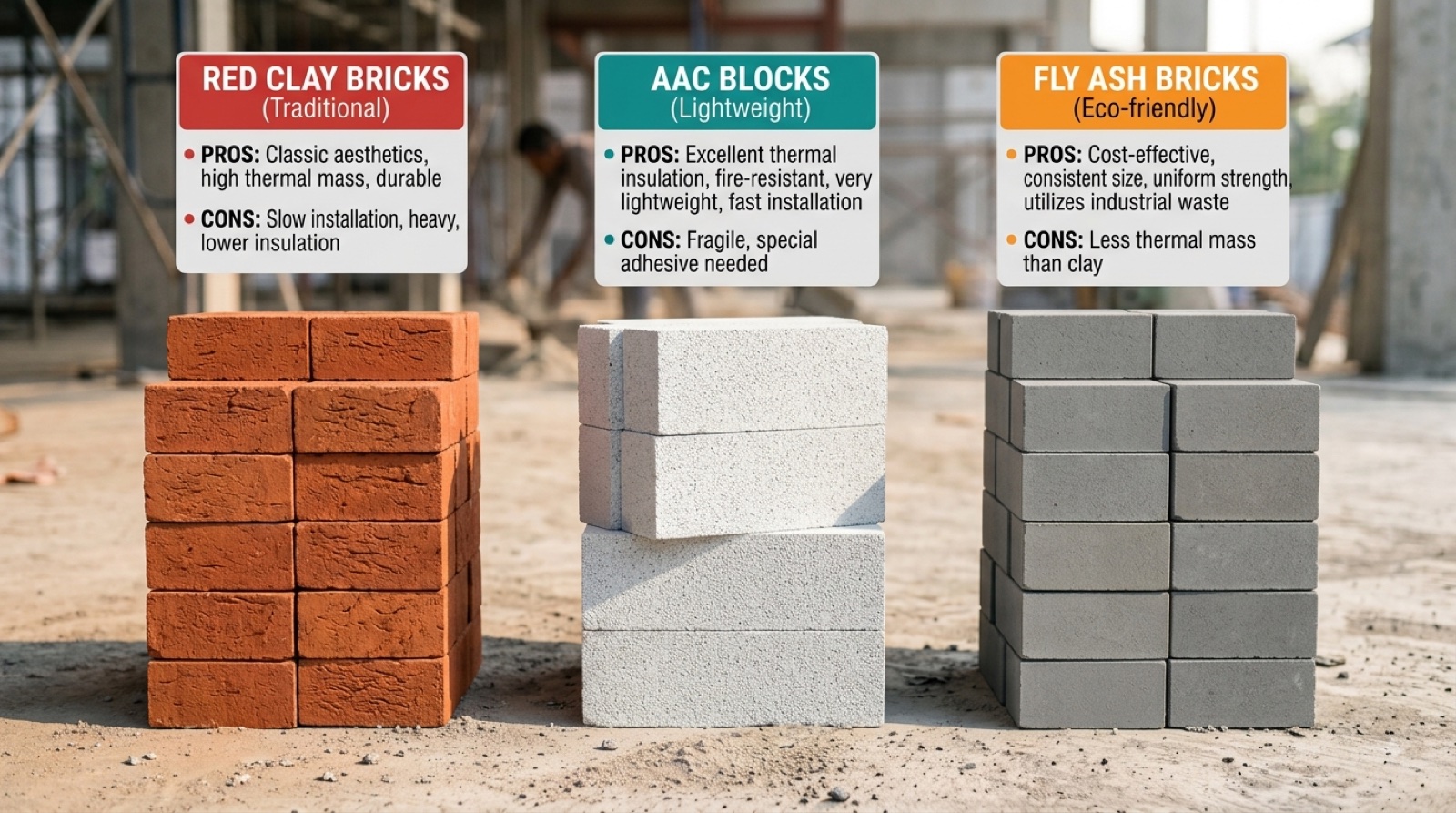
Choosing between AAC blocks, red clay bricks and fly ash bricks comes down to weight, strength, insulation and cost. In short, AAC blocks are the lightest and best insulated and suit faster, cooler, high-rise builds; red bricks are the traditional, strong-bonding choice for load-bearing walls; and fly ash bricks are a strong, uniform, eco-friendly middle ground. Here is the full comparison.
AAC vs red brick vs fly ash: full comparison table
| Factor | AAC Blocks | Red Clay Bricks | Fly Ash Bricks |
|---|---|---|---|
| Typical size | 600 x 200 x 100 to 230 mm | 230 x 110 x 75 mm | 230 x 110 x 75 mm |
| Weight / density | 550 to 650 kg/m³, about one third of clay | around 1800 kg/m³ | 1700 to 1850 kg/m³ |
| Compressive strength | 3 to 4.5 MPa | around 3.5 MPa (varies) | 7 to 10 MPa |
| Water absorption | Higher; needs block-fix mortar and proper curing | 15 to 20% | Low, typically under 12% |
| Thermal insulation | Best; low conductivity, cooler interiors, less AC load | Moderate | Moderate |
| Mortar needed | Least; large blocks, thin-bed joints | Most | Moderate |
| Dead load on structure | Lowest | Highest | High |
| Cost angle | Fewer units, less mortar and lower dead load can cut total cost | Low unit cost, more mortar and labour | Competitive and uniform |
| Best use | High-rise, fast-track, cooler buildings | Traditional load-bearing walls | Strong, eco-friendly all-rounder |
What are AAC blocks?
AAC stands for Autoclaved Aerated Concrete. Blocks are made from cement, lime, fine sand or fly ash and a small amount of aluminium powder, then cured with high-pressure steam in an autoclave. The reaction fills the block with millions of tiny air pockets, which is why AAC is so light, only about a third the density of clay, while staying dimensionally accurate.
That low weight and the trapped air give AAC two big advantages: excellent thermal insulation that keeps interiors cooler and cuts air-conditioning load, and a much lower dead load on the building. Because a single block replaces several bricks and is laid with a thin bed of block-fix adhesive, masonry goes up faster with far less mortar. The main things to respect are its higher water absorption, so it needs the correct thin-bed mortar, good curing and a suitable plaster, and slightly more care when fixing heavy wall-mounted items. Explore AAC blocks on Clyft.
What are red clay bricks?
Red bricks are the traditional burnt-clay unit used across India for generations, moulded from clay and fired in a kiln. They bond strongly with cement mortar, carry load well, and are widely available with a workforce that already knows how to lay them, which is why they remain the default for conventional load-bearing walls.
The trade-offs are weight and labour. At roughly 1800 kg/m³ they are around three times heavier than AAC, they absorb 15 to 20% water, and a wall needs many more units and much more mortar, so both dead load and masonry time are higher. Quality also varies from batch to batch depending on the clay and the kiln. See red bricks on Clyft.
What are fly ash bricks?
Fly ash bricks are made by compressing fly ash, a by-product of coal power plants, with cement, lime, sand and water. Reusing an industrial waste stream makes them the eco-friendly option, and the moulding process gives them a smooth, uniform shape and size. They are strong, commonly 7 to 10 MPa, absorb little water (typically under 12%), and work well for both load-bearing and partition walls. Density sits between clay and AAC at about 1700 to 1850 kg/m³, so they are still heavy, but their strength and consistency make them a dependable middle ground. Compare options across all products.
Weight, dead load and cost: why AAC changes the maths
Because AAC blocks are large and light, three things change on site. First, you need far fewer units and much less mortar per square metre, which saves material and labour time. Second, the low weight cuts the dead load the structure has to carry, and a lighter building can need less steel and a lighter foundation, savings that show up across the whole project even when the block costs more per unit. Third, the insulation reduces heat gain, so rooms stay cooler and air-conditioning runs less.
Red bricks reverse that picture: cheap per unit but heavier, with more mortar, more labour and higher dead load. Fly ash bricks land in between. The honest way to compare is total wall cost and lifetime running cost, not the price of a single unit. Check live prices for AAC blocks and red bricks on Clyft.
Thermal insulation and comfort
This is where AAC clearly leads. The air pockets give AAC a much lower thermal conductivity than solid clay or fly ash, so walls transfer less outdoor heat indoors. In hot Indian summers that means cooler rooms and a lighter load on air-conditioning, which lowers running costs over the life of the home. Red and fly ash bricks are denser and offer only moderate insulation by comparison.
Which should you choose?
- Choose AAC blocks for high-rise buildings, fast-track projects, and any home where a cooler interior and lower structural cost matter.
- Choose red bricks for traditional load-bearing construction, small extensions, and jobs where local masons and low unit cost are the priority.
- Choose fly ash bricks when you want a strong, uniform, eco-friendly brick that works for both load-bearing and partition walls.
Many modern homes mix them: AAC for partition and infill walls in a framed structure, and bricks where a solid load-bearing wall is specified.
Getting AAC installation right
Most complaints about AAC come down to how it is laid, not the block itself. Because AAC absorbs water and is lighter than brick, it rewards the correct method: lay the blocks with a thin-bed block-fix adhesive rather than thick sand-cement mortar, keep the joints thin and even, and cure and prepare the surface before plastering, ideally with a bonding agent or a suitable ready-mix plaster. For heavy wall-mounted items like TVs, geysers and cabinets, use anchors or fasteners rated for aerated concrete rather than ordinary nails. Done this way, AAC walls stay flat, strong and free of the hairline cracks that give badly laid blockwork a bad name.