For a standard 9-inch brick wall, plan for about 100 to 112 bricks per square metre. A 4.5-inch half-brick wall needs about 55 to 60, and an AAC block wall only about 8 to 9 blocks per square metre. Multiply by your wall area, subtract openings, and add about 5% for wastage. Here is how to work it out for any wall.
How many bricks per square metre?
Two brick sizes are common in India: the modular brick at 190 x 90 x 90 mm and the traditional brick at 230 x 110 x 75 mm. Add the standard 10 mm mortar joint on each face, and the count per square metre depends mainly on how thick the wall is.
| Wall type | Thickness | Units per square metre (approx) |
|---|---|---|
| Full-brick wall (9-inch) | 230 mm | 100 to 112 bricks |
| Half-brick wall (4.5-inch) | 115 mm | 55 to 60 bricks |
| AAC block wall | 200 mm | about 8 to 9 blocks |
A 9-inch wall is two brick-widths thick, so it uses roughly double the bricks of a 4.5-inch wall over the same face area. Treat these counts as planning figures and always confirm them against your actual brick size. Smaller modular bricks push the count toward the higher end, while larger traditional bricks and thicker mortar joints bring it down.
How many bricks per square foot?
Prefer to think in square feet? One square metre is about 10.76 square feet, so divide the per-square-metre figures by roughly 10.76:
- 9-inch brick wall: about 9 to 10 bricks per square foot.
- 4.5-inch brick wall: about 5 bricks per square foot.
- AAC block wall: roughly 0.8 blocks per square foot, or about 4 blocks for every 5 square feet.
For a quick site estimate, count around 10 bricks per square foot for a full-brick wall and about half that for a half-brick wall, then confirm with the square-metre method for your final order.
The 1 cubic metre rule: about 500 bricks
A quick way to estimate larger volumes of brickwork is the cubic-metre rule. A modular brick of 190 x 90 x 90 mm plus a 10 mm mortar joint occupies a neat 200 x 100 x 100 mm space, which is 0.002 m³. Divide 1 by 0.002 and you get about 500 modular bricks in one cubic metre of finished brickwork, mortar included. This is handy when your drawings give wall volume rather than face area.
How many AAC blocks per square metre?
AAC blocks are much bigger, so far fewer are needed. A common block presents a 600 x 200 mm face, which is 0.12 m² (0.6 x 0.2). One square metre of wall divided by 0.12 works out to about 8.3 blocks, so plan for roughly 8 to 9 blocks per square metre before mortar.
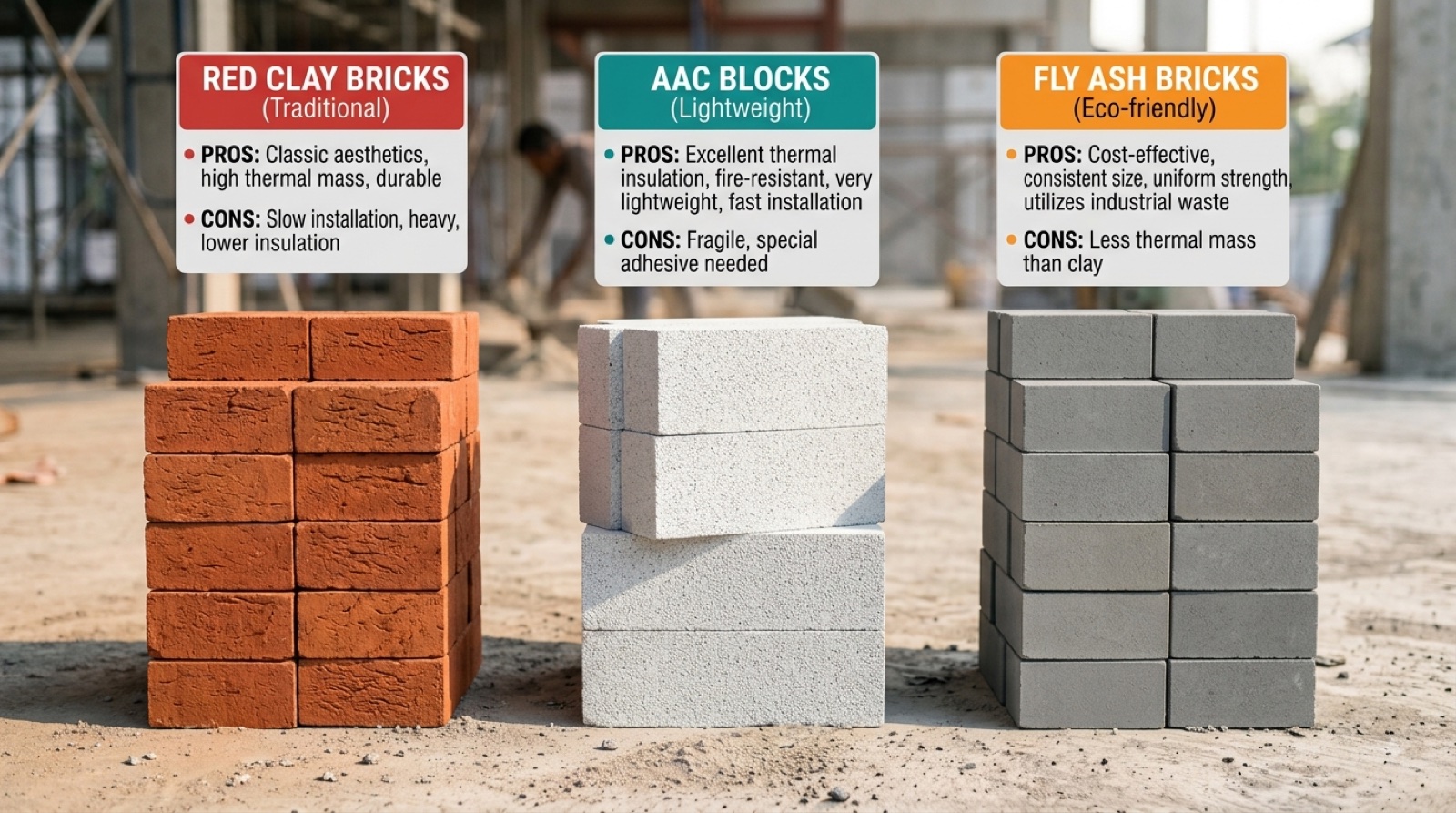
Because the blocks are laid with a thin bed of adhesive rather than thick mortar beds, an AAC wall also uses a fraction of the mortar a brick wall needs. That is a real saving in both material and labour time, and one of the reasons AAC is popular on fast-track sites. See how the materials compare in our guide to AAC blocks vs red bricks.
Worked example: a 10 ft x 10 ft wall
Say you are building a single-brick (9-inch) wall, 10 ft wide and 10 ft high.
- Wall area: 10 ft x 10 ft = 100 sq ft, which is about 9.3 m² (9.29 m² to be exact).
- Bricks before wastage: at about 100 bricks per m², that is 100 x 9.3, or roughly 930 bricks.
- Add wastage: add about 5% for breakage and cutting, so 930 plus about 47 comes to roughly 980 bricks.
- Subtract openings: if the wall has a door or window, work out that opening's area and remove its share of bricks before ordering.
So a plain 10 ft x 10 ft single-brick wall needs on the order of 980 bricks. The same wall in AAC blocks would take only about 9.3 x 8.5, or roughly 80 blocks.
How to calculate it for any wall
The method is the same every time:
- Measure the wall area: length x height, in square metres.
- Subtract openings: deduct the area of doors, windows and any gaps.
- Multiply by the per-square-metre count: use 100 to 112 for a 9-inch brick wall, 55 to 60 for a 4.5-inch wall, or 8 to 9 for an AAC block wall.
- Add about 5% for wastage: bricks break, corners get cut, and a small buffer avoids a second trip to reorder.
Do not forget the mortar
Bricks are only part of the order. Mortar typically fills about 20 to 30% of a brick wall's volume, depending on brick size and joint thickness, so budget cement and sand accordingly. AAC block walls flip this: the thin-bed block-fix adhesive fills only the narrow joints, so mortar quantity and cost drop sharply compared with traditional brickwork.
Ordering tip: round up to whole units
Bricks are usually quoted and sold per thousand, and AAC blocks by the piece or by the cubic metre, so once you have your net figure, round up to a sensible whole quantity rather than ordering an awkward part-count. Keeping the 5% wastage buffer means you are not held up mid-wall by a handful of broken units, and a small surplus of matching bricks or blocks is useful later for minor repairs or an added niche. If your project has several walls, total them all first, then apply wastage once to the combined figure, which is tidier than rounding each wall on its own.
Ready to order? Check live prices for red bricks and AAC blocks on Clyft.