The walls you choose shape your home's cost, weight, insulation and build speed. This guide compares the three main walling materials sold in India, red clay bricks, AAC blocks and fly ash bricks, and shows how to estimate how many units your walls need.
Quick answer: which walling material
| Material | Strengths | Best for |
|---|---|---|
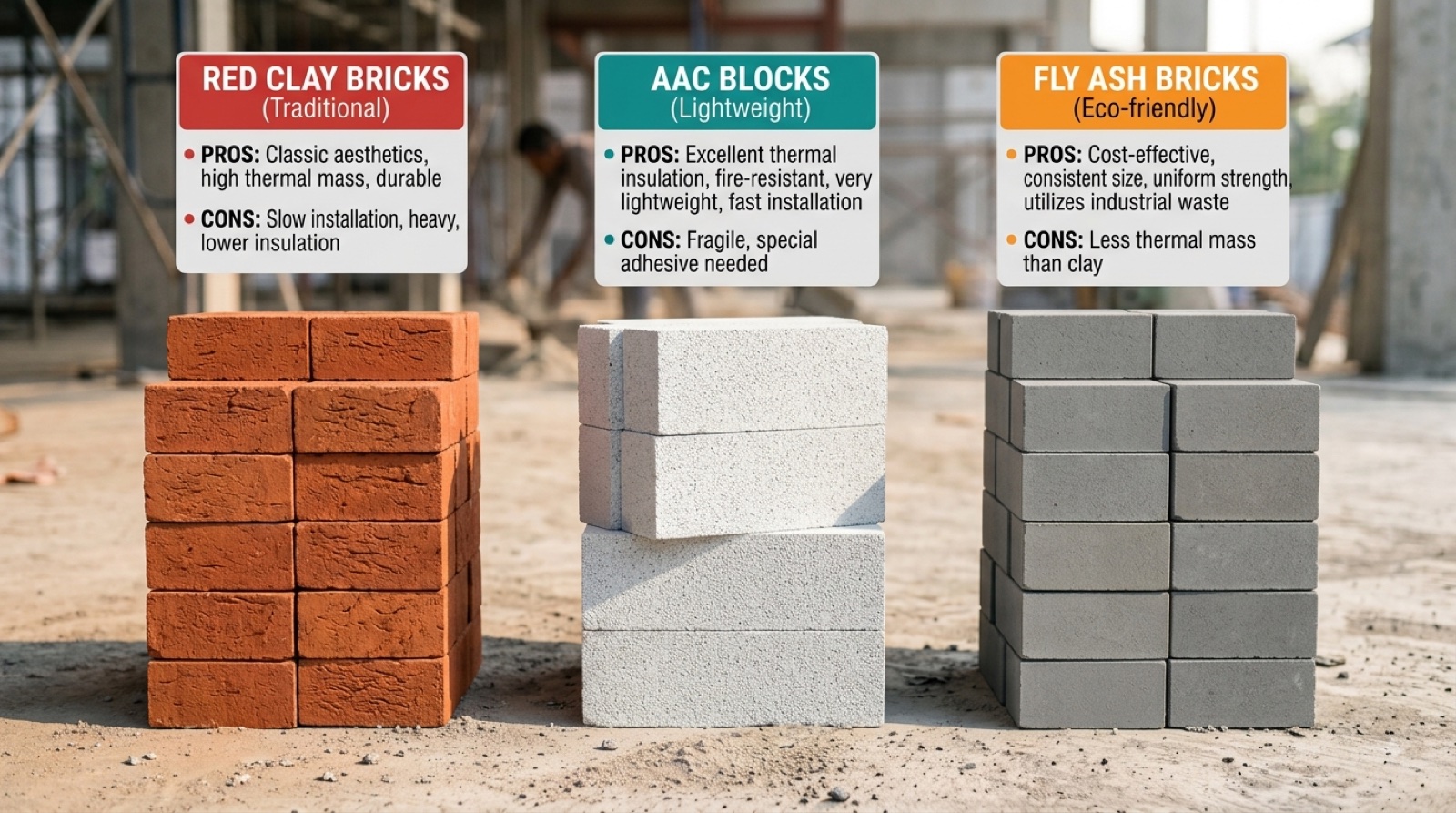
| Red clay bricks | Proven bond, load-bearing, widely available | Traditional and low-rise load-bearing walls |
| AAC blocks | Light, well insulated, fast to lay | Framed high-rise, hot climates, modern builds |
| Fly ash bricks | Strong, accurate size, eco-friendly | Cost-sensitive projects wanting a clean finish |
How they compare
Red clay bricks have been used for generations and bond very well with mortar, which is why they remain standard for load-bearing walls. AAC (Autoclaved Aerated Concrete) blocks are made with air pockets, so they are light and insulate against heat and sound, reducing both structural load and cooling bills. Fly ash bricks are made from power-plant fly ash, are dimensionally accurate and usually stronger than clay bricks, and use industrial waste, so they are the eco-conscious cost pick.
For the full side-by-side on weight, water absorption, strength and cost, read our AAC blocks vs red bricks vs fly ash comparison.
Strength at a glance
For most low-rise homes all three materials are structurally adequate, and the engineer sizes the design to the chosen material:
- AAC blocks: about 3 to 4.5 MPa compressive strength
- Red clay bricks: around 3.5 MPa, though batch quality varies
- Fly ash bricks: usually 7 to 10 MPa
Strength is rarely the deciding factor for a normal house; weight, insulation, finish and total cost usually matter more.
How many you need
Work from wall area and thickness:
- A 100 mm brick wall needs about 55 bricks per square metre including mortar.
- A 200 mm brick wall needs roughly double.
- AAC blocks cover the same area with far fewer units because each block is much larger, which is a big part of their labour saving.
Our bricks per square metre calculation guide gives the exact method so you order the right quantity with a sensible buffer for breakage.
Buying checklist
- Decide load-bearing or framed: load-bearing favours clay or fly ash brick, framed favours AAC.
- Compare total wall cost (units plus mortar plus labour), not unit price.
- For AAC, budget for thin-bed block adhesive, not thick cement mortar.
- Check units for consistent size and no cracks; accurate units save on plaster.
- Account for breakage with a small ordering buffer.
Buy bricks and blocks on Clyft
Clyft delivers red bricks and AAC blocks direct from manufacturers across Hyderabad and up to 50 km around the city, usually within 24 hours. Browse the red bricks collection and the AAC blocks collection, or order on the Clyft app.