House wiring in India is quoted in two ways, per electrical point or per square foot of built-up area, and the two numbers answer different questions. As a working figure for 2026, a with-material point rate runs about ₹700 to ₹1,600 per point, and full concealed wiring for a home lands around ₹90 to ₹200 per sq ft including material and labour. A 2 BHK typically comes to somewhere between ₹85,000 and ₹1,80,000 all in. This guide breaks down where each of those numbers comes from, what a point rate does and does not cover, and what 1, 2 and 3 BHK homes actually consume in cable and fittings.
Electrical work rate list 2026, at a glance:
| What is quoted | Typical 2026 rate | Notes |
|---|---|---|
| Point rate, labour only | ₹180 – ₹350 per point | You buy all material |
| Point rate, with material | ₹700 – ₹1,600 per point | Standard modular switches, FR copper |
| Point rate, premium | ₹1,600 – ₹3,000 per point | Branded switches, FR-LSH cable |
| Wiring cost per sq ft, basic | ₹90 – ₹130 per sq ft | Material + labour, concealed |
| Wiring cost per sq ft, standard | ₹130 – ₹200 per sq ft | Material + labour, concealed |
| 1 BHK, all in | ₹55,000 – ₹1,10,000 | 35 – 50 points |
| 2 BHK, all in | ₹85,000 – ₹1,80,000 | 50 – 75 points |
| 3 BHK, all in | ₹1,30,000 – ₹2,80,000 | 75 – 110 points |
Rates below are indicative ranges for Indian cities as of early 2026. Cable in particular is priced off copper, which moves week to week, so treat the material figures as a planning baseline and check live wire and cable prices close to the day you actually buy.
What Is an Electrical Point?
Almost every wiring quote in India is built on the point, so getting the definition right is the difference between comparing two quotes fairly and being surprised at the end of the job.
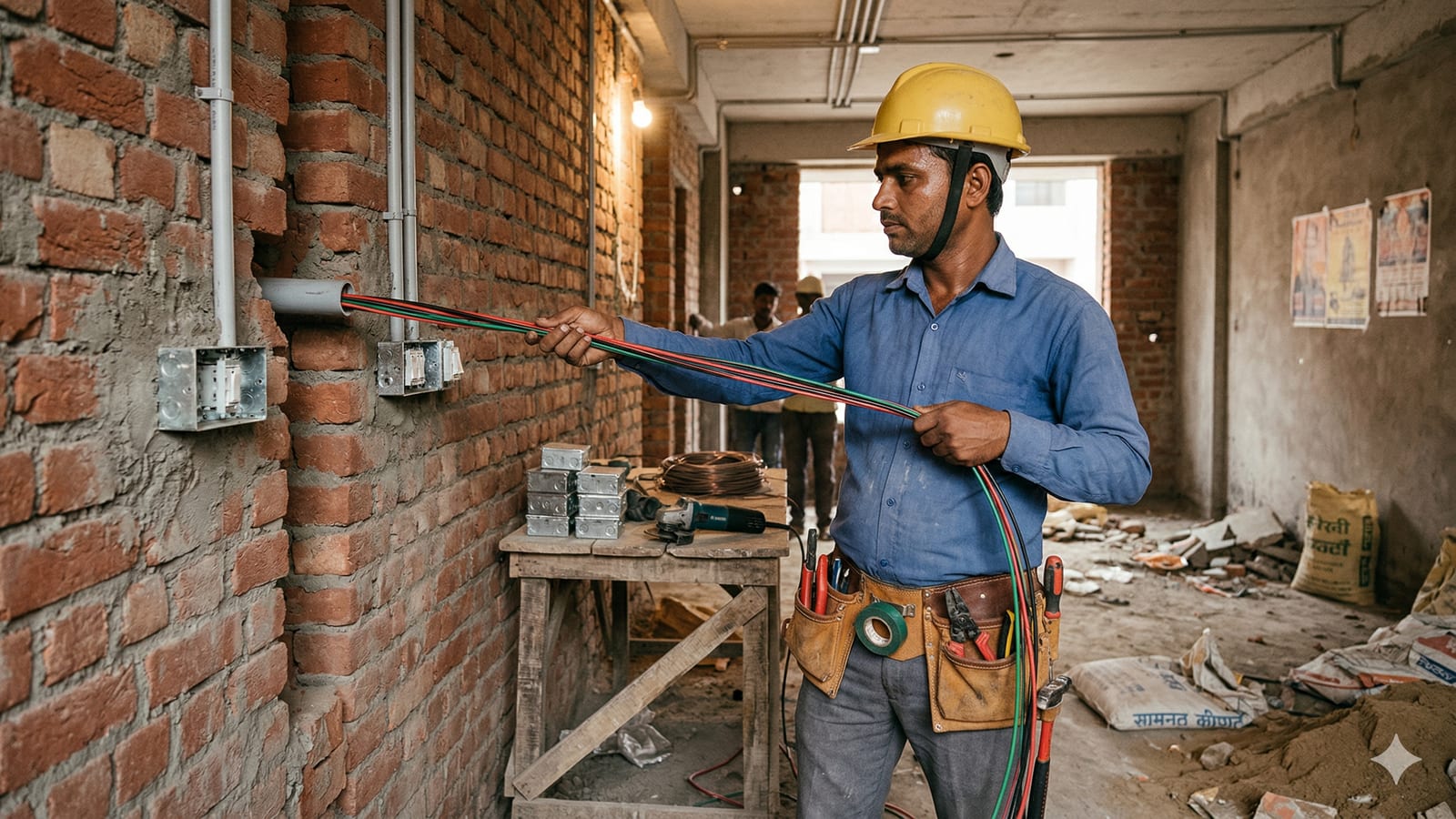
A point is one terminated outlet: one light, one fan, one switch-controlled socket, one AC outlet. The count includes the wire run from the distribution board, the conduit it runs inside, the wall box, the switch or socket itself and the labour to install and terminate it.
That means the point count for a home is much higher than most people first guess. Every ceiling light, every wall light, every fan, every 5A socket, every 15A socket, every AC outlet, the geyser, the exhaust fan, the doorbell and every TV or internet outlet is its own point.
What Is the Electrical Point Rate in 2026?
The single most common source of confusion in wiring quotes is that two very different numbers both get called "the point rate."
| What the quote covers | Indicative rate per point | What you supply |
|---|---|---|
| Labour only | ₹180 to ₹350 | All cable, conduit, boxes, switches |
| With basic material | ₹700 to ₹1,600 | Nothing, contractor supplies standard material |
| With premium material | ₹1,600 to ₹3,000 | Nothing, branded modular switches and FR grade copper |
Before comparing two quotes, confirm three things: whether the rate is labour only or with material, which brand and grade of cable is included, and which switch range is included. A quote that looks 30 percent cheaper is very often quoting labour only, or quoting a lower switch series, rather than genuinely being cheaper for the same work.
What a Point Rate Does Not Include
Even a with-material point rate normally excludes the items below, and these are what push a quote from "per point subtotal" to "final bill."
- The distribution board, MCBs and RCCB. The DB itself, the individual MCBs and the RCCB are usually billed separately, typically ₹6,000 to ₹25,000 depending on the number of ways and the brand. See MCB vs RCCB vs MCCB for what each device is actually protecting.
- Mains and incomer cable. The heavy 6 or 10 sq mm run from the meter to the DB is measured and billed by the metre, not per point.
- Earthing. A proper earth pit with the electrode, salt, charcoal and chamber usually runs ₹4,000 to ₹12,000 per pit.
- Light fittings and fans. The point rate ends at the terminated outlet. The actual fixture, fan or chandelier is your purchase.
- Chasing and civil repair. In concealed wiring, cutting channels in the wall and refilling them is sometimes quoted separately, especially on a renovation rather than new construction.
What Is the Wiring Cost Per Sq Ft?
Per sq ft is the quicker way to sanity check a quote before you have a final point count. It is a broader number because it usually absorbs the DB, mains and earthing that the point rate leaves out.
| Specification | Cost per sq ft | What it looks like |
|---|---|---|
| Basic | ₹90 to ₹130 | Standard local switches, ISI copper cable, minimum point count |
| Standard | ₹130 to ₹200 | Branded modular switches, FR copper cable, dedicated AC circuits |
| Premium | ₹200 to ₹350+ | Premium switch ranges, FRLSH cable, false ceiling lighting, automation |
Use it as a cross-check rather than a quote. If your point-based total works out to ₹80 per sq ft on a 3 BHK, the point count is almost certainly too low for the home, and you will be paying for the missing points later as extras.
Wiring Cost by BHK
This is the part most people are actually looking for. The table below assumes new construction with concealed wiring, a standard specification, and includes the distribution board, earthing and mains alongside the point work.
| Home | Typical area | Points | Copper cable | Indicative total |
|---|---|---|---|---|
| 1 BHK | 450 to 600 sq ft | 30 to 45 | 400 to 550 m | ₹45,000 to ₹90,000 |
| 2 BHK | 800 to 1,100 sq ft | 50 to 75 | 700 to 1,100 m | ₹85,000 to ₹1,80,000 |
| 3 BHK | 1,200 to 1,600 sq ft | 80 to 110 | 1,300 to 1,800 m | ₹1,40,000 to ₹3,00,000 |
| 4 BHK or duplex | 2,000 sq ft and up | 120 to 180 | 2,000 m and up | ₹2,40,000 and up |
The ranges are wide on purpose, and the reason is worth internalising before you budget: the spread inside one BHK size is driven far more by specification than by area. A 2 BHK wired with premium modular switches, FRLSH cable and four AC points genuinely costs close to double the same 2 BHK wired to a basic specification with two AC points. Fix the specification first, then the total becomes predictable.
Where the Money Goes on a 2 BHK
Taking a standard-specification 2 BHK of roughly 1,000 sq ft and about 60 points as the worked example, a typical split looks like this.
| Line item | Share of total |
|---|---|
| Copper cable and conduit | 30 to 35% |
| Switches, sockets and plates | 20 to 25% |
| Distribution board, MCBs, RCCB | 8 to 12% |
| Earthing and mains | 5 to 8% |
| Labour | 30 to 40% |
Material is therefore roughly 60 to 70 percent of the bill and labour 30 to 40 percent. That ratio is the single most useful thing to know before negotiating, because it tells you that shaving the labour rate is fighting over the smaller half, while buying cable and switchgear well is where the real money is.
How Much Wire Does a House Need?
The house wiring calculator works this out from your point count and returns the coils by size. Cable is not one size bought in bulk, it is four or five sizes bought in proportion. Coils are sold in 90 m, 180 m, 200 m and 300 m lengths, so plan in coils rather than loose metres.
| Size | Used for | Rough share of a home's total |
|---|---|---|
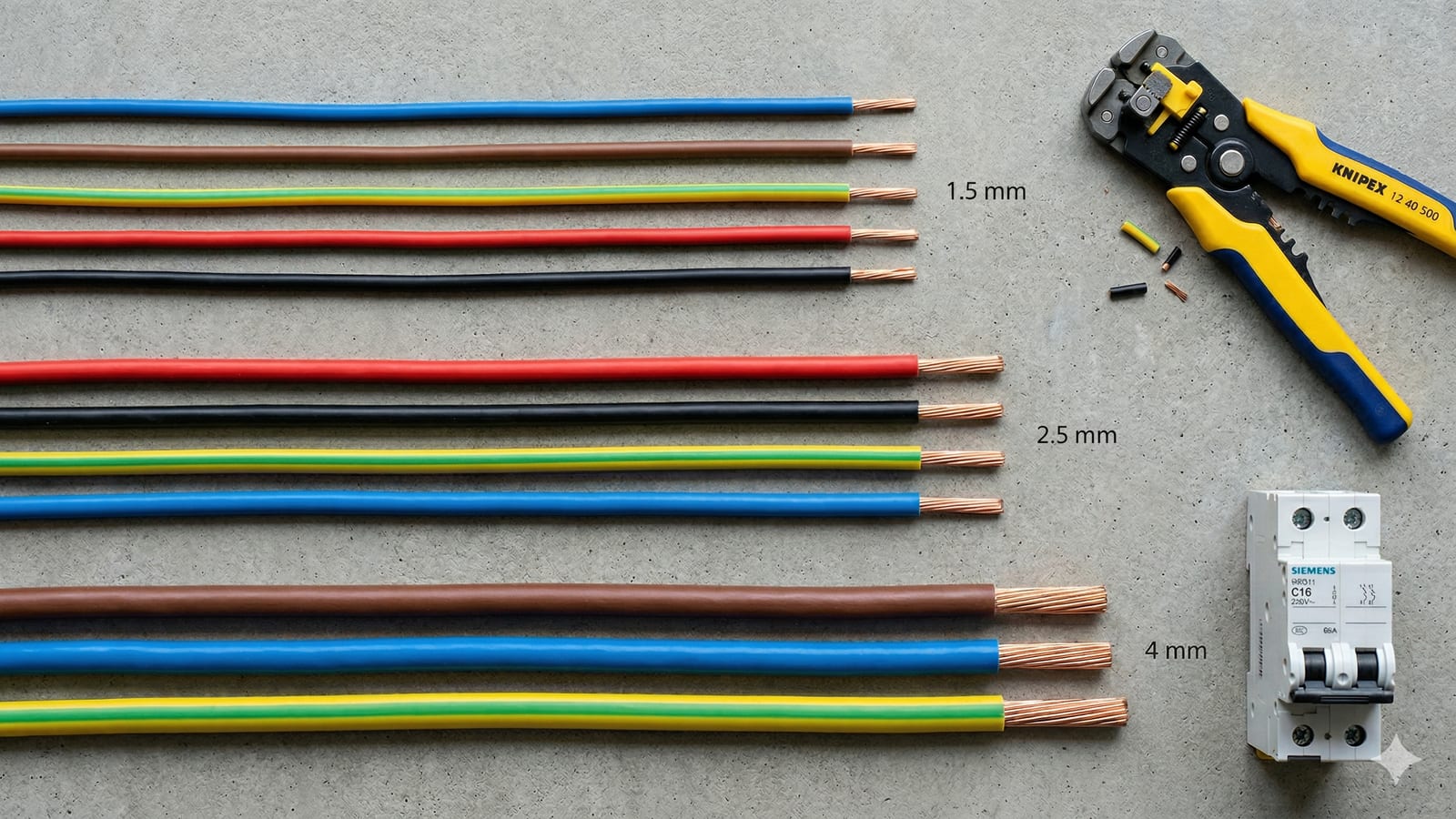
| 1.0 to 1.5 sq mm | Lighting and fan circuits | 35 to 45% |
| 2.5 sq mm | Power and socket circuits | 30 to 40% |
| 4 sq mm | AC, geyser, dedicated appliance circuits | 10 to 20% |
| 6 or 10 sq mm | Mains and incomer | 5 to 10% |
For a 1,000 sq ft 2 BHK, that works out to roughly 700 to 1,100 m in total, or about 8 to 12 coils of 90 m across the sizes. Buy about 10 percent more than the calculated figure, because cable runs are never as short as the drawing suggests once conduits turn corners and drop to boxes.
If you are not sure which size belongs where, the electrical wire size guide covers ampacity by size, and the house wiring guide covers how to split the load into circuits in the first place.
What Makes One Quote Higher Than Another?
Six variables account for nearly all the difference between two quotes on the same home.
- Switch brand and series. This is the largest single swing. Premium modular ranges can cost several times a basic modular plate for functionally identical switching, and on an 80 point home that difference compounds fast.
- Cable grade. Plain PVC, FR (flame retardant) and FRLSH (flame retardant low smoke halogen) sit at rising price points. FR is the sensible default for a home, and FRLSH is worth it in enclosed spaces and stairwells where smoke matters.
- Concealed versus surface conduit. Concealed wiring costs more in both labour and civil work than surface conduit, and is the norm in new residential construction.
- Number of AC and heavy appliance points. Each one is a dedicated 4 sq mm circuit with its own MCB, so it costs meaningfully more than a lighting point.
- Single phase versus three phase. A three phase connection means a larger DB, more incomer cable and load balancing across phases.
- Automation and false ceiling lighting. Smart switches, dimmers and dense cove lighting raise both the point count and the per-point cost.
How to Reduce Wiring Cost Safely
There is a clean line between savings that cost you nothing and savings that cost you a house fire. The ones worth taking:
- Buy material yourself. Contractor material markup is typically the largest avoidable cost in the whole job. Buying cable and switchgear at transparent, quoted prices and paying labour separately usually beats a single bundled per-point number.
- Finalise the point layout before work starts. Every point moved after the conduit is cast means fresh chasing, fresh cable and fresh civil repair. Walk the plan room by room with furniture positions in mind.
- Tier your switch specification by room. Premium ranges in the living room and master bedroom, standard ranges in utility areas, bathrooms and the kitchen balcony. Nobody has ever noticed a switch plate in a store room.
- Buy cable in full coils. Cut lengths carry a premium over sealed 90 m or 180 m coils, and a home needs enough of every size that full coils rarely go to waste.
And the ones that are never worth taking, at any saving: undersizing cable below what the circuit draws, skipping the RCCB, using aluminium conductor for internal circuits, sharing one circuit across multiple heavy appliances, and skipping a proper earth pit. Each of these saves a few thousand rupees once and creates a permanent hazard in a house you will live in for decades.
Getting Your Own Number
Building in Hyderabad? Wiring is one of the last big material bills of a build, and the earlier ones, cement, steel, blocks and bricks, are where the bigger savings sit. Buy construction materials in Hyderabad through Clyft and verified suppliers quote on the whole list, usually within ten minutes.
The reliable sequence is to count points room by room, apply a with-material point rate from two or three local quotes, then add the distribution board, earthing, mains and fixtures as separate line items. Cross-check the total against the per sq ft table above, and if the two methods disagree by more than about 20 percent, the point count is usually what is wrong.
Because cable tracks copper prices, the material half of your estimate is the half that goes stale fastest. Check today's wire and cable prices in Hyderabad, updated daily, or current cable prices when you are ready to buy rather than budgeting off a figure from a few months ago, and use the construction calculator to size the rest of the material list for the build.
Get the lowest prices in Hyderabad in just 10 minutes!
Tell us the brand and quantity. Verified suppliers quote, you see the lowest, and most orders arrive within 24 hours.