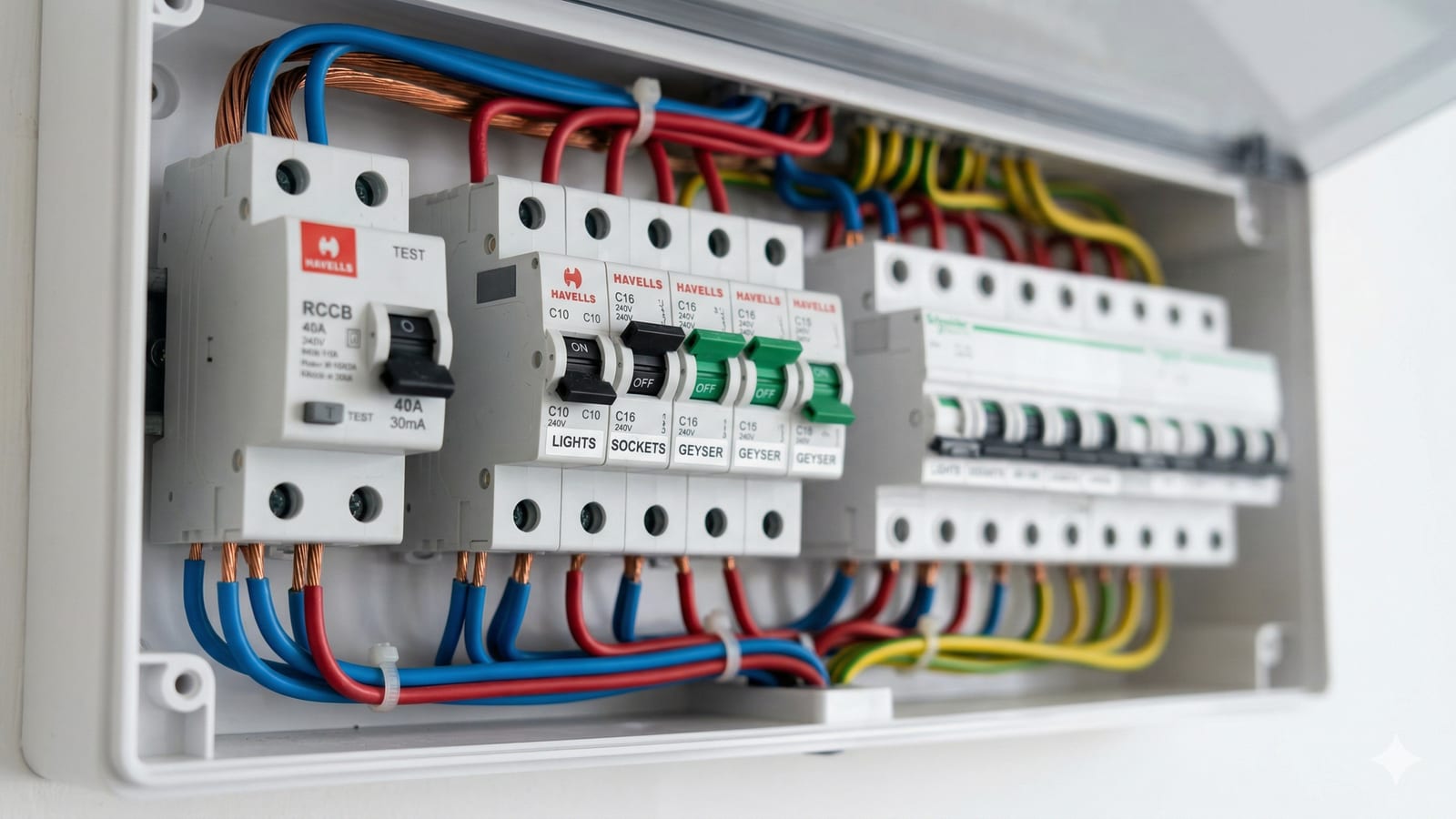
The switches in your distribution board (DB) look similar but do very different jobs. In short: an MCB protects the wiring from overload and short circuit, an RCCB protects people from electric shock and earth leakage, an MCCB is a heavier breaker for high currents, an RCBO combines an MCB and RCCB in one, and an isolator is just a manual on/off switch with no automatic tripping. This guide explains each one, its typical rating and where it belongs.
MCB vs RCCB vs MCCB at a glance
| Device | Protects against | Typical rating | Where used |
|---|---|---|---|
| MCB | Overload, short circuit | 6 to 32 A at home (up to ~100 A) | One per circuit in the DB |
| RCCB | Earth leakage, electric shock | 30 mA at home (100 or 300 mA for fire) | After the incomer, ahead of the MCBs |
| MCCB | Overload, short circuit at high current | 100 to 1000 A, often adjustable | Main incomer of large homes / commercial |
| RCBO | Earth leakage + overload + short circuit | 6 to 40 A, 30 mA | A single circuit needing full protection |
| Isolator / main switch | Nothing (manual disconnect only) | Rated to the supply | Main switch to cut power for maintenance |
What is an MCB?
A Miniature Circuit Breaker protects the wiring. It trips automatically on two faults: an overload (steady current above the cable's safe limit, for example too many appliances on one circuit) and a short circuit (a sudden, very large current). By cutting the circuit before the cable overheats, the MCB is your main defence against electrical fire.
MCBs are rated by the current at which they trip. At home this is typically 6 to 32 A, one MCB per circuit, matched to that circuit's wire size: a 6 to 10 A MCB for lighting, 16 to 20 A for sockets, and 20 to 32 A for heavy appliances. They are made to IS/IEC 60898 and are available up to around 100 A. What an MCB does not do is detect earth leakage, so it cannot protect a person from shock.
What is an RCCB?
A Residual Current Circuit Breaker protects people. It continuously compares the current leaving on the live conductor with the current returning on the neutral. In a healthy circuit these are equal. If some current is leaking to earth, for instance through a person touching a live part, the two no longer balance, and the RCCB disconnects the supply within milliseconds.
For homes, the standard sensitivity is 30 mA, low enough to protect against a dangerous shock. Higher sensitivities of 100 mA or 300 mA are used mainly on the mains for fire protection, where the concern is leakage current starting a fire rather than protecting an individual. Crucially, an RCCB does not protect against overload or short circuit by itself, so it always works alongside MCBs, never instead of them.
What is an MCCB?
A Moulded Case Circuit Breaker is, in effect, a bigger, tougher MCB for higher currents. It protects against overload and short circuit like an MCB, but it is built for currents from roughly 100 A up to 1000 A, and its trip settings are often adjustable. In homes you only meet an MCCB as the main incomer of a large house with heavy total load, in most homes an MCCB is not needed and a rated main switch does the job. MCCBs are common on commercial and industrial boards.
What is an RCBO?
An RCBO (Residual Current Breaker with Overload) puts an RCCB and an MCB into one device. It trips on earth leakage and on overload and short circuit, giving a single circuit complete protection in one compact module. RCBOs are handy when you want one important circuit protected on its own, so a leakage fault on that circuit does not trip the whole board through a shared RCCB.
What is an isolator or main switch?
An isolator (or main switch) simply disconnects power manually. It has no automatic trip of any kind, it does not sense overload, short circuit or leakage. Its job is to let you safely cut all power to the board or a section of it for maintenance or in an emergency. Do not mistake an isolator for protection, it is a switch, not a breaker.
How a home distribution board is arranged
The order of devices in the board matters, because protection is applied from the incoming supply outward. A typical home DB is arranged like this:
- Incomer isolator or MCCB, the main switch that brings supply into the board and lets you cut it all off.
- RCCB (30 mA), sitting just after the incomer so every downstream circuit is covered by earth-leakage protection.
- A row of MCBs, one per circuit, each rated to its cable: lighting, sockets, AC, geyser, kitchen and so on.
Power flows incomer to RCCB to MCBs to your circuits. Larger homes may use more than one RCCB, or RCBOs on selected circuits, so that a single leakage fault does not black out the entire house.
The most common mistake: MCB but no RCCB
The single most dangerous shortcut in home wiring is fitting only MCBs and no RCCB. It is easy to assume a board full of breakers is fully protected, but MCBs guard the cables, not people. They react to overload and short circuit, not to the small leakage current that flows when someone receives a shock. Without an RCCB, a faulty geyser, a frayed appliance cord or a wet wall can leave a surface live with no device fast enough to save a person. Every home should have at least one 30 mA RCCB protecting its circuits, working together with the MCBs, not in place of them.
Fit the right device for each job, MCBs on every circuit, an RCCB for shock protection, an isolator to cut power safely, and step up to MCCBs or RCBOs where the load calls for it. To wire it all up, browse ISI-marked copper cable on wires and cables, or see the full range in all products.