A safe home wiring plan is not one long run of cable, it is the total electrical load split into separate circuits, each sized correctly and protected on its own device at the distribution board (DB). Lighting goes on thin cable and small breakers, power sockets on thicker cable, and every heavy appliance gets its own dedicated circuit. Add proper earthing and an RCCB for shock protection, and you have a home that is both safe and easy to fault-find. This guide walks through the whole plan.
What does a safe house wiring plan look like?
Everything starts at the distribution board, the panel where the incoming supply is split and protected. From the DB you run separate circuits so that a fault, overload or repair on one never takes down the rest of the house. A typical Indian home is divided into four kinds of circuit: lighting, power and sockets, dedicated heavy-appliance circuits, and the mains that feeds the board itself.
House wiring circuit chart
| Circuit | Wire size | MCB rating | Protects |
|---|---|---|---|
| Lighting | 1.0 to 1.5 sq mm | 6 to 10 A | Bulbs, tube lights, fans, light points |
| Power sockets | 2.5 sq mm | 16 to 20 A | General plug points, TV, fridge, chargers |
| Air conditioner | 4 sq mm | 20 to 32 A | 1 to 2 ton AC, on its own circuit |
| Geyser | 4 sq mm | 20 A | Water heater, on its own circuit |
| Kitchen / hob | 4 to 6 sq mm | 20 to 32 A | Induction, microwave, heavy kitchen load |
| Mains / incomer | 6 to 10 sq mm | Main isolator / MCCB | The whole-home supply |
The main circuits in an Indian home
Lighting circuits
Lights and fans draw little current, so lighting runs in 1.0 to 1.5 sq mm cable on a 6 to 10 A MCB. Larger homes split lighting across two or more circuits so one tripped breaker never darkens the entire house. Keeping lighting separate from sockets is a basic safety habit worth following.
Power and socket circuits
General plug points, the television, fridge and everyday appliances sit on power circuits wired in 2.5 sq mm cable and protected by a 16 to 20 A MCB. Spread your sockets across more than one power circuit in a bigger home rather than loading everything onto a single breaker.
Dedicated circuits for heavy appliances
High-wattage appliances must each have their own circuit straight from the DB, never shared with sockets. An air conditioner is typically 4 sq mm on a 20 to 32 A MCB, a geyser 4 sq mm on a 20 A MCB, and a kitchen hob or induction load 4 to 6 sq mm. Dedicating a circuit to each means the appliance gets clean, correctly protected power and a fault stays contained.
Mains and incomer
The incomer feeds the whole board and carries the sum of every circuit, so it is the heaviest cable in the house, usually 6 to 10 sq mm, controlled by a main switch or MCCB. Size it from a real load estimate (see below) so the mains is never the weak point.
Earthing and RCCB: the two things you cannot skip
Two elements protect people, not just cables, and neither is optional:
- Earthing. Every circuit needs an earth conductor (the green, or green-and-yellow, wire) running back to a proper earth pit. Earthing gives fault current a safe path to ground and is what allows protective devices to operate. Without it, a leaking appliance body can stay live and dangerous.
- RCCB. A Residual Current Circuit Breaker at the DB constantly compares the current going out against the current coming back. If some current is leaking to earth, for example through a person, it trips in milliseconds. Homes use a 30 mA RCCB for shock protection. Ordinary MCBs cannot detect earth leakage, so an RCCB is essential, not a nice-to-have.
Single-phase or three-phase supply?
Most homes run on a single-phase supply, which is simpler and comfortably serves connected loads up to roughly 5 to 7 kW. Larger houses, with several air conditioners, powerful motors or a lift, are better on a three-phase supply that spreads the demand across three lines. The right choice comes out of your load estimate: add up the wattage of everything that can run at once, apply a diversity allowance, and you know both the supply type and the size of your main and DB.
How to plan your home wiring, step by step
- Do a load estimate. List every appliance and light, add up the realistic simultaneous load, and use it to fix the supply type (single or three phase) and the mains size.
- Split the load into circuits. Separate lighting, power sockets and one dedicated circuit per heavy appliance, as in the chart above.
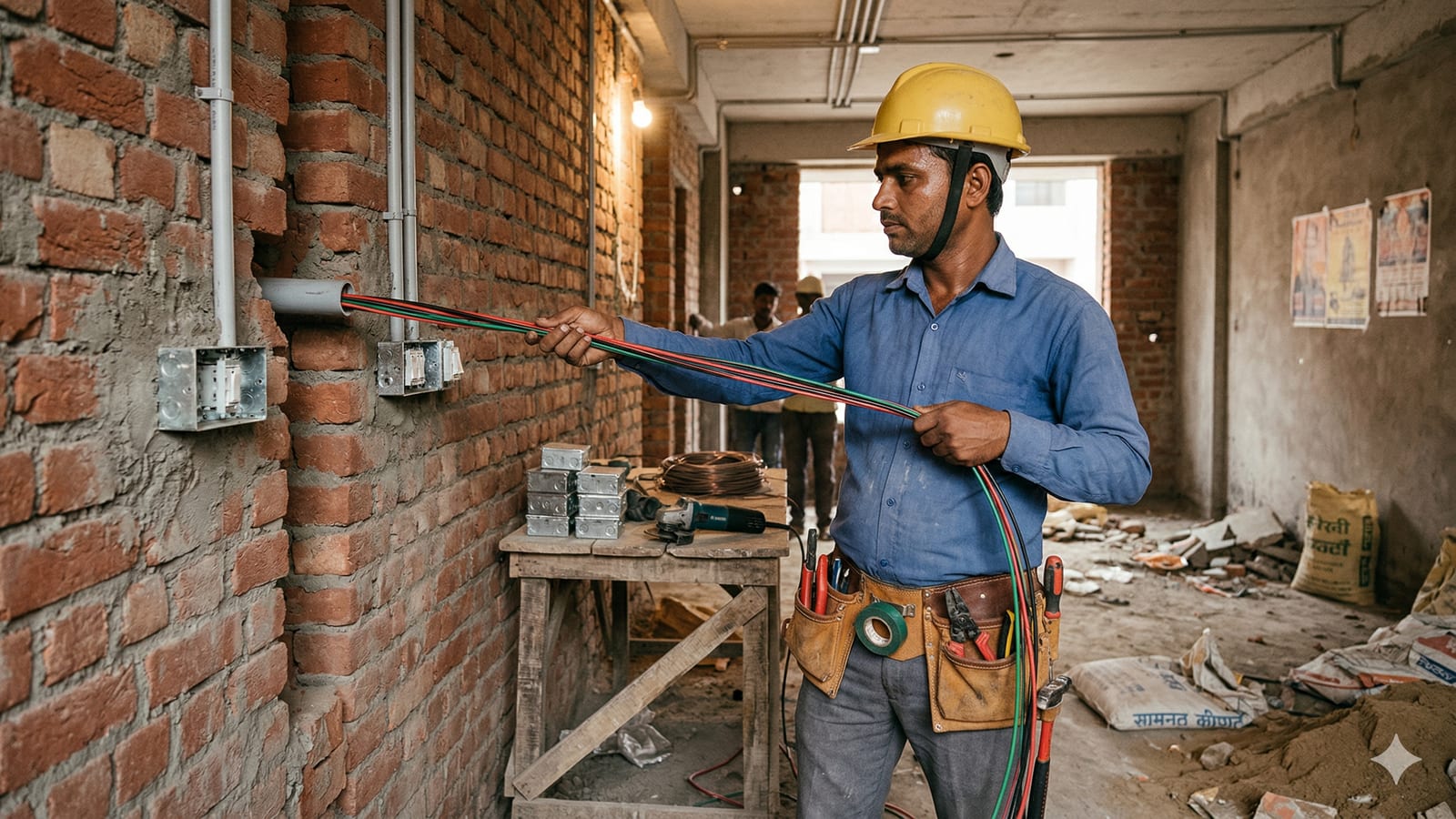
- Run the conduits and pull the cable. Lay concealed conduit, then pull ISI-marked copper cable of the correct sq mm for each circuit, keeping consistent wire colours throughout.
- Build the distribution board. Fit a main isolator or MCCB, then an RCCB (30 mA), then a row of MCBs, one per circuit at the correct rating.
- Earth everything. Connect every circuit's earth conductor back to a proper earth pit.
- Test before energising. Have the installation checked for continuity, insulation resistance, correct polarity and RCCB tripping before it is switched on.
Wiring safety do's and don'ts
- Do use a licensed electrician, home wiring is not a place to improvise.
- Do use ISI-marked copper cable sized correctly for each circuit.
- Do fit an RCCB, it is the only device that protects against electric shock.
- Don't overload a single socket or circuit with multiboards and high-wattage appliances.
- Don't mix heavy appliances onto general socket circuits, give each its own.
- Don't skip earthing on any circuit, ever.
Wire colour codes
Consistent colours keep the installation safe to work on later. Current Indian practice uses brown, black or grey for phase (older wiring used red, yellow or blue), blue for neutral (older black), and green, or green-and-yellow, for earth. Never reuse the earth colour for anything else.
Plan the circuits, size the cable, protect each one on its own device, add an RCCB and earth everything, and you have wiring that is safe for the life of the home. Ready to buy? Browse ISI-marked copper cable on wires and cables, or see the full range in all products.