Electrical point rates in India sit within one national band, roughly ₹180 to ₹350 per point for labour only and ₹700 to ₹1,600 per point with standard material, and the differences between cities are smaller than most people expect. The reason is simple: material is national, labour is local. Cable, switches and MCBs cost close to the same in Hyderabad as in Mumbai, so almost all the city-to-city spread comes from the labour share. This guide explains where each city sits, why, and how to read a quote wherever you are building.
The one thing that actually varies
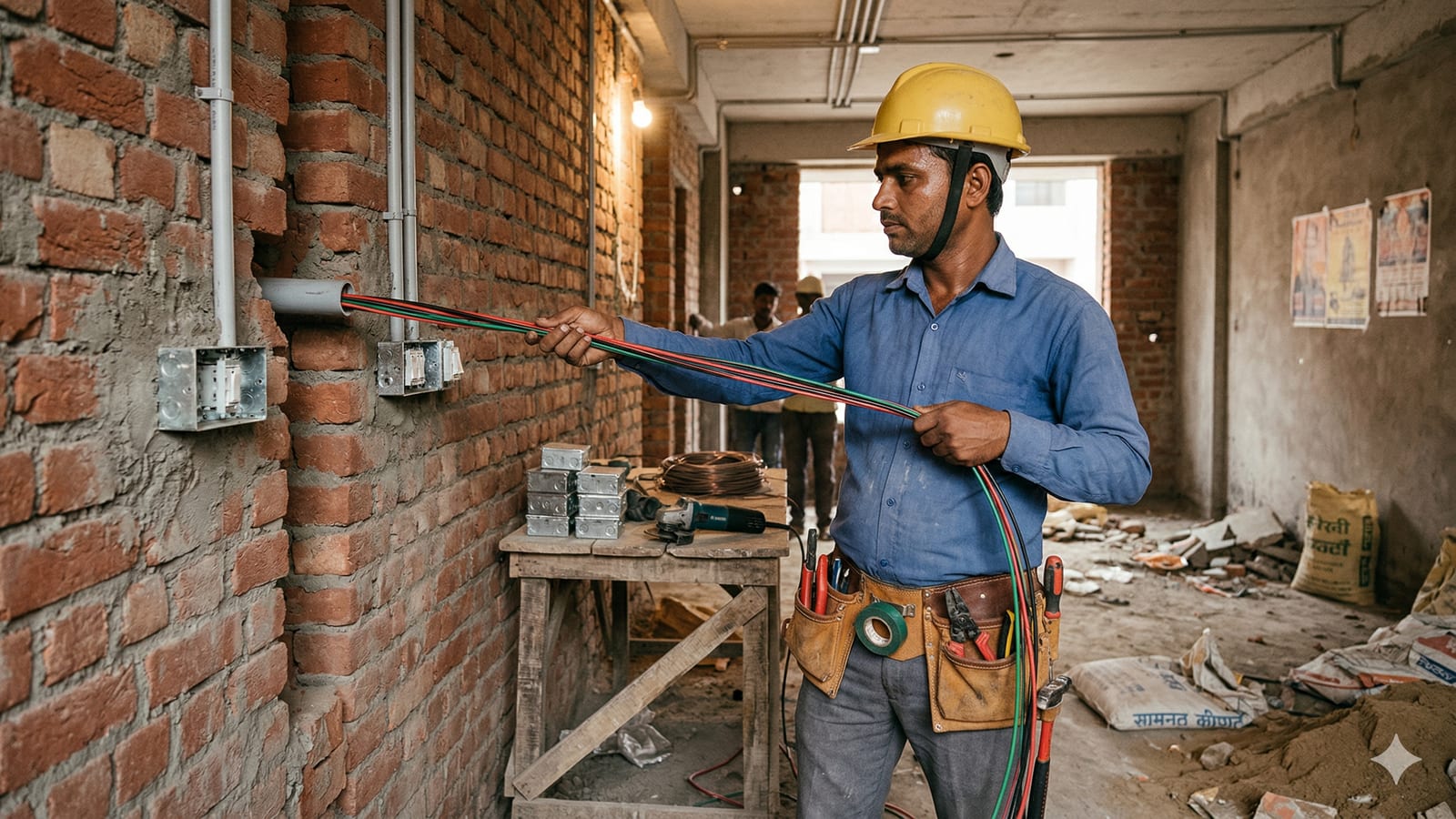
An electrical point is one terminated outlet: a light, fan, socket or switch, with its conduit, cable and box. A quote is built from two pieces:
- Material, which is roughly 60 to 70 percent of a with-material point rate. Copper cable, modular switches, boxes, conduit and protective devices are national commodities. Copper in particular is priced off a global market, so it barely varies by city.
- Labour, which is roughly 30 to 40 percent. This is set by local wage levels, demand and site conditions.
So when you compare a Mumbai quote to a Hyderabad quote, you are mostly comparing the labour third. That is why labour-only rates differ most between cities, and with-material rates differ least.
Indicative positioning by city
| City | Where it typically sits in the national band | Why |
|---|---|---|
| Mumbai | Upper end | High labour costs, difficult site access, high-rise logistics |
| Delhi NCR | Upper end | High labour costs, large market with wide variation |
| Bangalore | Middle to upper | Strong construction demand, competitive contractor market |
| Hyderabad | Middle | Competitive contractor market, good material availability |
| Pune, Chennai, Ahmedabad | Middle | Established markets, broad contractor supply |
| Tier 2 cities | Lower end | Lower labour rates, though material cost is unchanged |
Treat this as positioning within the national band, not as a price list. Within-city variation between contractors is routinely larger than the difference between two cities. Two quotes on the same street can differ by more than the gap between a Hyderabad average and a Mumbai average, which is why collecting two or three local quotes matters far more than knowing your city's average.
The national band to measure any quote against
| What the quote covers | Indicative rate per point | What you supply |
|---|---|---|
| Labour only | ₹180 to ₹350 | All cable, conduit, boxes, switches |
| With basic material | ₹700 to ₹1,600 | Nothing, contractor supplies standard material |
| With premium material | ₹1,600 to ₹3,000 | Nothing, branded modular and FR grade copper |
A quote well outside these bands is worth questioning in either direction. Far below usually means undersized cable, non-ISI material or an undercounted point list. Far above should come with a specification that justifies it.
How to compare quotes properly
- Get the point count in writing, room by room. The count drives the total far more than the rate does.
- Fix what "material" means. Which cable brand, which insulation grade, which switch range. A with-material rate is meaningless without this.
- Ask what is excluded. Light fittings, fans, drivers, dimmers and the distribution board are usually separate.
- Cross-check against per square foot. Whole-home electrical work typically runs ₹90 to ₹350 per sq ft of built-up area by specification. If your point-based total and your per sq ft figure disagree by more than about 20 percent, the point count is usually what is wrong.
- Compare like for like on grade. A quote using FRLS cable should not be compared against one using plain PVC.
What does not change by city
- IS 694 is the standard for copper building wire everywhere in India, and the ISI mark is the thing to check on every coil.
- Wire sizes are the same: 1.5 sq mm lighting, 2.5 sq mm sockets, 4 sq mm for a geyser or AC, 6 to 10 sq mm mains.
- Safety requirements do not relax anywhere. Every circuit earthed, every heavy appliance on its own dedicated circuit and protective device.
For the sizing rules, see the electrical wire size guide.
Wherever you are building, the method is the same: get the point count in writing, pin down what material means, and measure the quote against the national band rather than against a number someone quoted a friend. Browse ISI-marked copper cable on wires and cables, or see the full catalogue in all products.