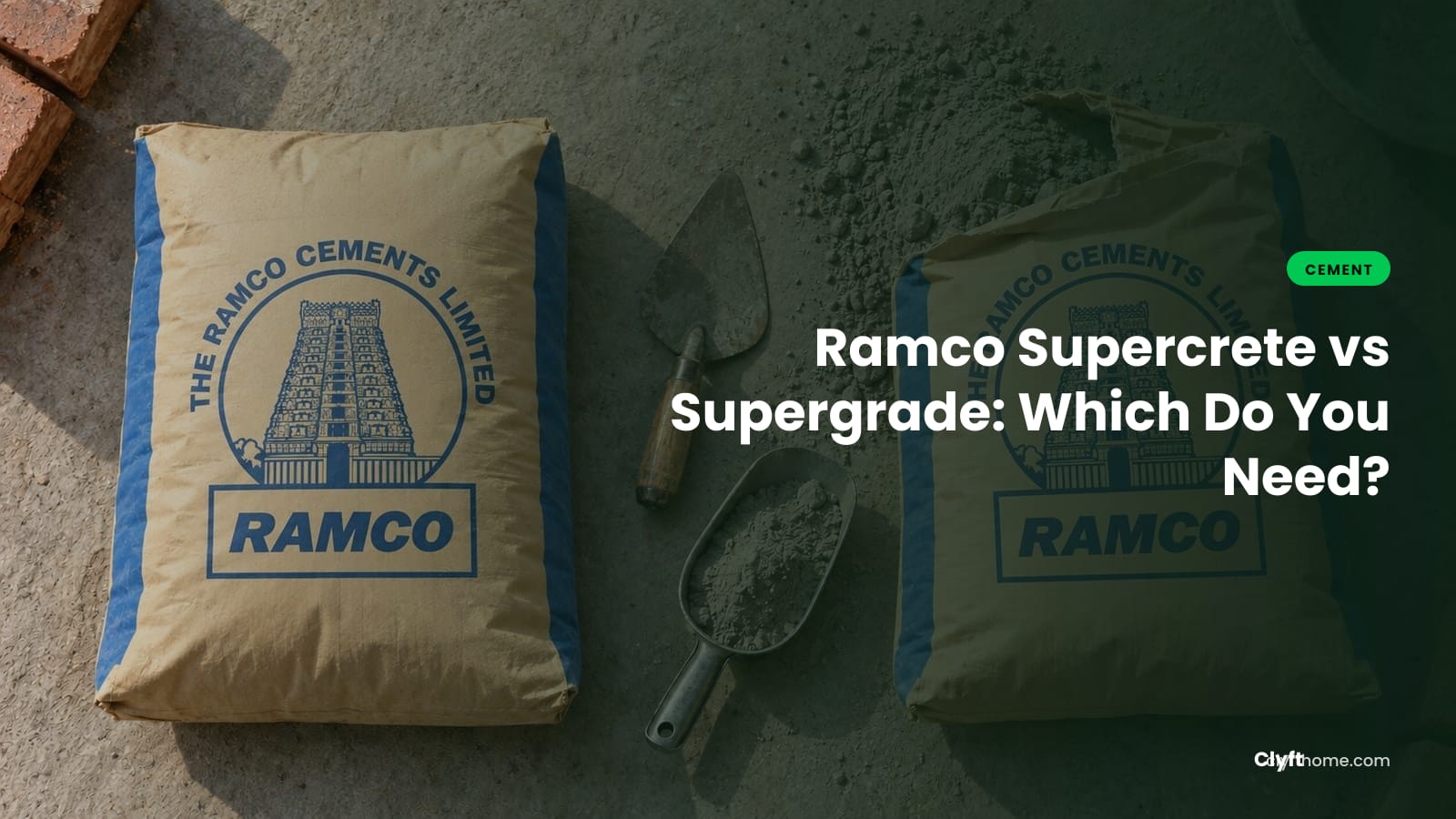
Supercrete and Supergrade are trade names, not technical specifications. Which one you should buy depends entirely on what the IS number printed on the bag says, because that is what determines how the cement behaves: IS 269 is Ordinary Portland Cement, carrying a 43 or 53 grade, and IS 1489 Part 1 is Portland Pozzolana Cement. This guide covers how to tell the two apart in the yard, and which belongs in which part of your build.
Why the name on the bag is not the specification
Indian cement carries two layers of naming. The standard underneath is set by the Bureau of Indian Standards and defines composition and minimum strength. The trade name on top is marketing, and manufacturers routinely sell OPC and blended cement under similar-sounding sub-brands.
Those sub-brands are not consistent between manufacturers, can change between regions, and are not required to indicate the type. So two bags from the same manufacturer with similar names can be genuinely different materials.
The IS number settles it in seconds, every time.
The three-second check
| If the bag shows | It is | And belongs in |
|---|---|---|
| IS 269, with 43 or 53 printed | Ordinary Portland Cement | Structural concrete: slabs, beams, columns |
| IS 1489 Part 1 | Portland Pozzolana Cement | Masonry, plaster, general construction |
| IS 455 | Portland Slag Cement | Coastal and chemically aggressive conditions |
A useful shortcut: OPC carries a grade number, blended cement generally does not. If you cannot find a 43 or 53 anywhere on the bag, you are most likely holding a blended cement.
Which one for which job
Structural concrete
Slabs, beams, columns and anything carrying load want OPC, and usually 53 grade where formwork needs to come off on schedule. OPC gains strength fastest, which is precisely what structural work is buying.
The trade-off is heat. OPC generates more heat as it sets, which is a disadvantage in thick sections and in hot weather, where it raises the risk of thermal cracking. That is a curing problem to manage, not a reason to avoid it.
Masonry and plaster
Brickwork, block work and plaster are better served by a blended cement to IS 1489 Part 1. It is more workable under the trowel, generates less heat, and continues to gain durability well beyond 28 days. It is also usually a little cheaper.
Using 53 grade OPC for plaster is a common and needless expense. It costs more and brings no benefit to a non-structural application.
A sensible split
Most residential sites are best served by buying both: OPC for the structural pours, blended cement for masonry and plaster. Ordering one type for the entire project is simpler logistically and worse technically.
Comparing the two on price
Once you know which bag is which type, price comparison becomes straightforward, with one rule: compare only within the same type and grade.
A blended cement priced below an OPC of the same brand is not a better deal, it is a different material. The comparison that tells you something is blended against blended, or 53 grade OPC against 53 grade OPC, across suppliers.
And in both cases, check the packing date on the bags actually being unloaded. Cement draws moisture and loses strength as it ages, so use stock within about three months. A fresher bag at the same price is straightforwardly the better buy.
At delivery
- BIS certification mark and licence number present and readable.
- IS number matching the type you ordered.
- Grade printed, if you ordered OPC.
- Packing date within about three months.
- Bags loose to the touch. Lumps felt through the packaging mean moisture has already got in.
- Dry raised storage ready before the load arrives, off the floor and away from external walls.
Ignore the name on the front, read the IS number on the side, and match the type to the element you are pouring. See current rates on cement, or browse the full catalogue in all products.